




Probate administration Florida: From Appointment to Final Accounting
Probate administration in Florida involves a series of structured steps that many families find overwhelming. At Rubino Findley, PLLC, we guide personal representatives through each phase, from court appointment to final accounting.
This guide walks you through the entire process so you understand what to expect and how to avoid costly mistakes.
What Happens When Florida Probate Begins
Florida probate administration follows a precise legal framework established in Florida Statutes Chapters 731-735. When someone passes away with assets in their name alone, probate becomes the court process that transfers those assets to heirs or beneficiaries. The process moves through distinct phases, each with hard deadlines that cannot be ignored.
Filing the Will and Triggering the Process
You must file the original will with the circuit court clerk within 10 days of learning about the death. This initial filing triggers a series of cascading obligations that span months or even years, depending on estate complexity. The court then appoints a personal representative, sometimes called an executor, who becomes the legal authority managing the entire estate. This person holds significant responsibility: identifying all assets, notifying creditors, paying legitimate debts, filing tax returns, and ultimately distributing what remains to the rightful beneficiaries.
The Personal Representative’s Fiduciary Duties
The personal representative is not simply a caretaker but a fiduciary with obligations that exceed what many people initially understand. According to The Florida Bar Consumer Pamphlet on Probate in Florida, the personal representative must be at least 18 years old, mentally competent, and have no felony convictions. If the personal representative is not a Florida resident, they must be a close relative or have the court approve an alternative arrangement.
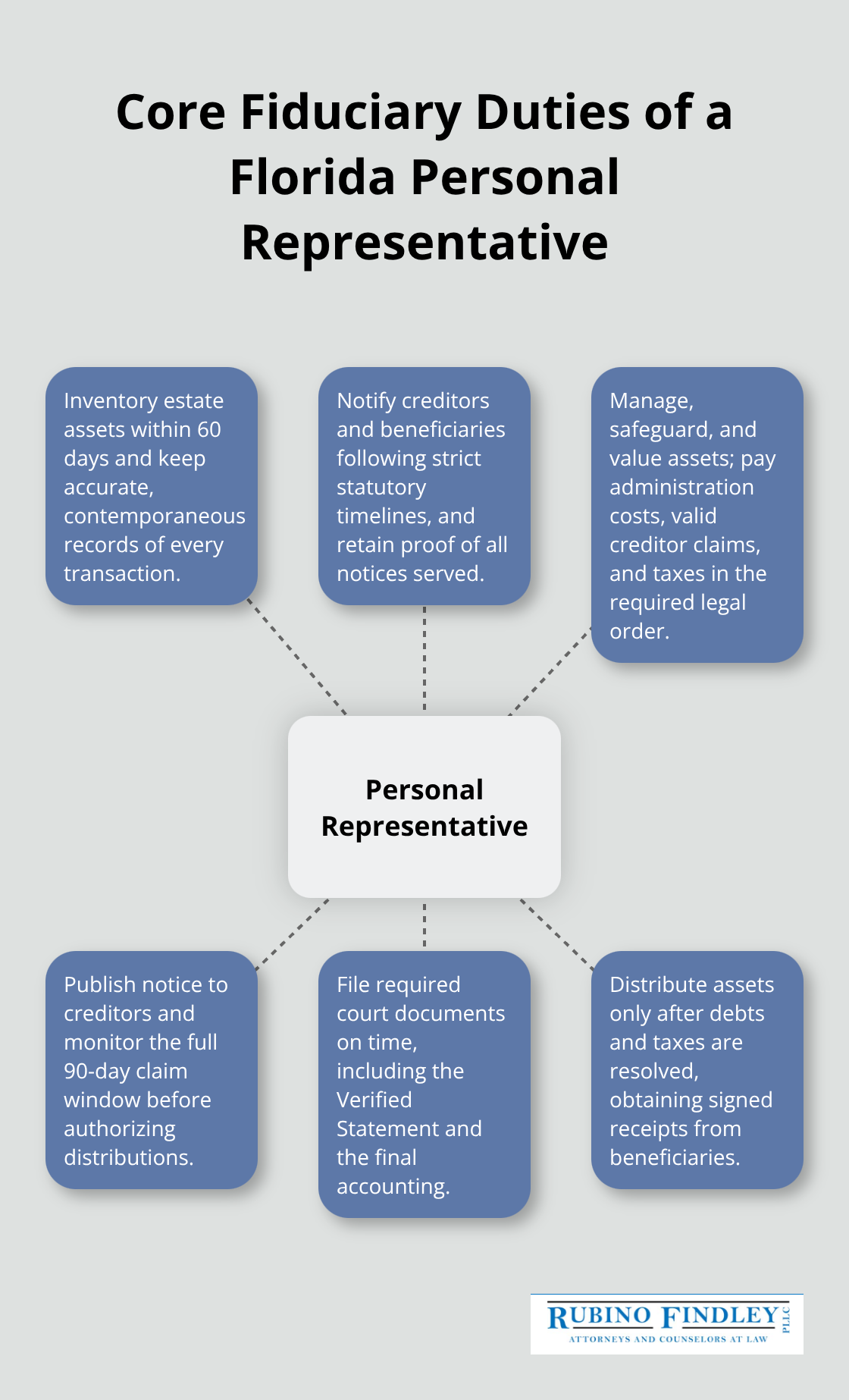
The court issues Letters of Administration, a document that proves their authority to act on behalf of the estate. From that moment forward, the personal representative must inventory all estate assets within 60 days, notify creditors and beneficiaries according to strict timelines, and maintain detailed records of every transaction.
The personal representative cannot distribute money or property to beneficiaries whenever they wish. Instead, they must follow a legal hierarchy: first, pay funeral expenses and administration costs; second, satisfy creditor claims within the statutory period; third, pay state and federal taxes; and only then distribute remaining assets to beneficiaries. Failure to follow this order can result in personal liability if a creditor or beneficiary later challenges the distribution.
Critical Deadlines That Drive the Timeline
Simple Florida probate estates typically take 5 to 6 months from start to finish, while standard formal administrations often run 6 to 12 months or longer, according to The Florida Bar. Complex estates involving multiple properties, family disputes, or tax complications can extend well beyond one year. The timeline begins when the court issues Letters of Administration, which typically happens within 1 to 4 weeks of filing.
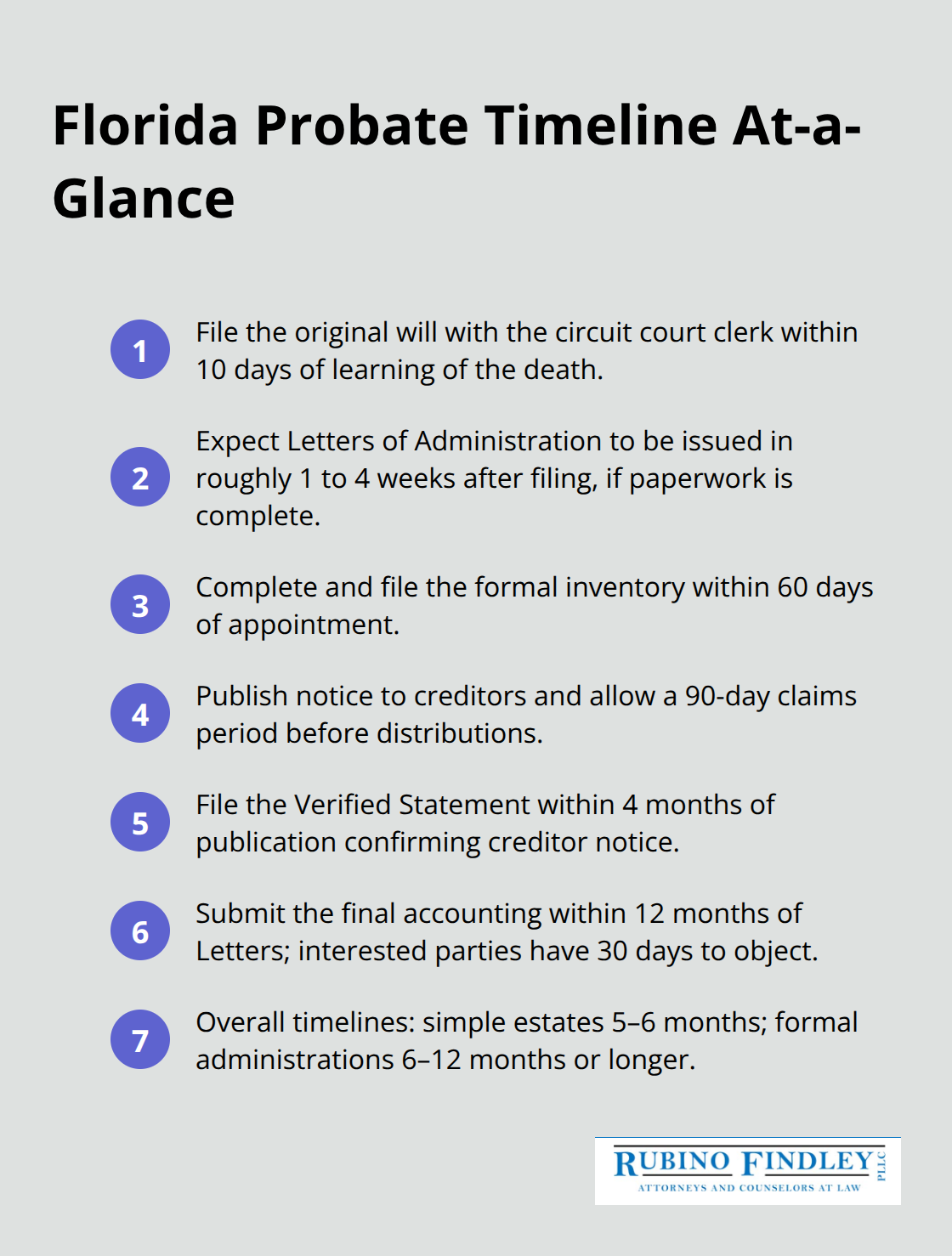
Once Letters are issued, the personal representative must publish notice to creditors in a local newspaper; creditors then have 90 days from the date of publication to file claims against the estate.
Within 4 months of publication, the personal representative must file a Verified Statement confirming that all potential creditors have been identified and notified. Asset distribution cannot occur until creditor claims are resolved and taxes are paid. The final accounting must be filed within 12 months of the Letters of Administration, and interested parties have 30 days to object to the accounting after it is filed. Only after the court approves the final accounting and grants estate closure does the personal representative’s work conclude.
Why Deadlines Matter in Palm Beach County Probate
Missing any of these deadlines creates delays and complications that ripple through the entire process. A single missed creditor notice deadline can extend the timeline by months. An incomplete inventory filed after the 60-day window invites court scrutiny and potential objections from beneficiaries. These procedural requirements exist to protect creditors, beneficiaries, and the integrity of the estate administration itself. The personal representative who understands these deadlines and acts with precision keeps the process moving forward and avoids unnecessary court intervention.
The next phase of probate administration focuses on the specific duties that begin immediately after the court appoints the personal representative and issues Letters of Administration.
Getting the Court Appointment Process Right in Boca Raton
Filing the Petition for Administration
After you file the original will with the circuit court clerk within 10 days of the death, the court moves quickly to establish the personal representative’s authority. The petition for administration is not a formality-it is the legal document that asks the court to recognize your appointment and grant you Letters of Administration. Filing this petition correctly matters because incomplete paperwork delays Letters by weeks, and every week delays the entire probate timeline. The court typically issues Letters within 1 to 4 weeks after filing, according to The Florida Bar, but only if the petition is thorough and accurate.
At this stage, you must disclose all known heirs and beneficiaries, describe the estate’s assets to the best of your knowledge, and explain why you are qualified to serve. If you are not a Florida resident and not a close relative, the court may require additional documentation or reject your petition outright. Many personal representatives make the mistake of underestimating asset values or omitting property entirely because they rush through the petition. This creates problems later when the actual inventory reveals assets that were not disclosed.
Understanding Your Authority and Immediate Obligations
Once the court approves the petition and issues Letters of Administration, you gain legal authority to act, but that authority comes with immediate and non-negotiable duties. Your first obligation is to inventory every asset the decedent owned at death. Florida Statute 733.604 requires you to complete this inventory within 60 days and file it with the court. This is not a rough estimate-it is a detailed accounting of bank accounts with current balances, real estate with fair market values, vehicles, personal property, retirement accounts, and any other asset held in the decedent’s name.
You must also identify which assets bypass probate entirely, such as property with named beneficiaries, life insurance proceeds, or accounts titled in joint tenancy with rights of survivorship. Courts scrutinize petitions carefully, and beneficiaries often object if they suspect the petition misrepresents the estate’s true size or composition.
Publishing Notice and Serving Beneficiaries
Simultaneously with your inventory work, you must publish notice to creditors in a local newspaper and serve notice of administration on all beneficiaries and heirs. According to The Florida Bar Consumer Pamphlet, creditors then have 90 days from the publication date to file claims. This is where many personal representatives stumble: they publish notice but fail to maintain proof of publication, or they serve notice incorrectly and face objections later.
You must use reliable service methods, such as certified mail or courier with proof of delivery, and file those proofs with the court. If you miss the 4-month deadline to file your verified statement confirming all creditors have been identified, the court may extend the probate timeline or require additional procedures.
Valuing Assets and Managing Complex Property
For real property valuation, hire a qualified appraiser if the property’s value is disputed or if the will references it. Do not rely on tax assessments or online estimates-courts expect professional appraisals for significant assets. If you are managing multiple properties or complex assets, consider working with professionals early, including a CPA and probate attorney, to establish clear processes and avoid costly corrections later.
The next critical phase involves notifying creditors and managing their claims, which directly affects how quickly you can settle the estate’s debts and move toward final distribution.
Settling Creditor Claims and Distributing the Estate
Managing the 90-Day Creditor Claims Period
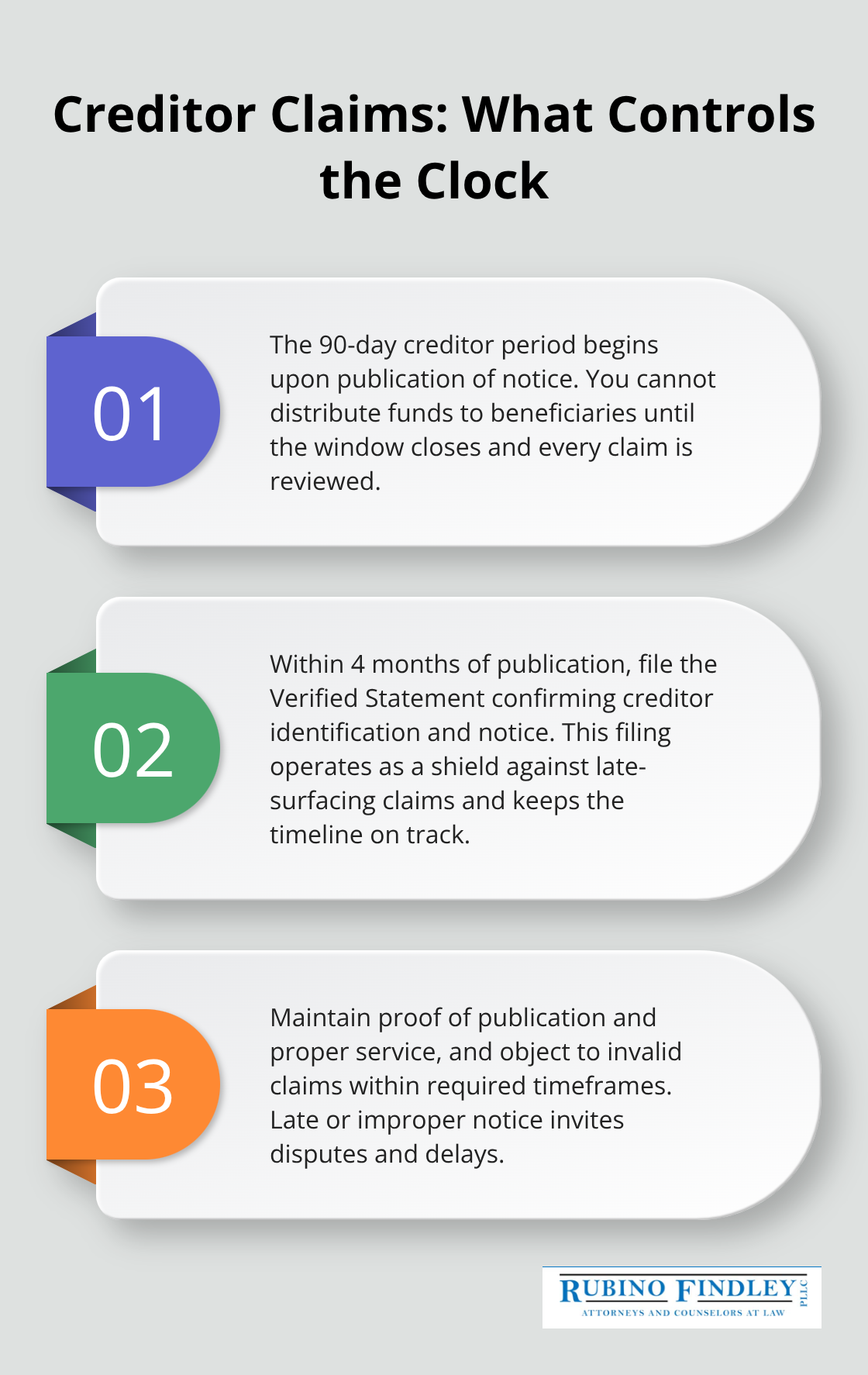
The moment you publish notice to creditors, you start a 90-day clock that controls much of the remaining probate timeline. According to The Florida Bar Consumer Pamphlet on Probate in Florida, creditors have exactly 90 days from the publication date to file claims against the estate, and any claim filed after that deadline is automatically waived. This means you cannot distribute a single dollar to beneficiaries until that 90-day period closes and you have reviewed every claim received.
Within 4 months of publishing notice, you must file a Verified Statement with the court confirming that you have identified all potential creditors and provided them with proper notice. This document serves as your protection against future claims surfacing after distributions have been made.
Handling Invalid and Contested Claims
If a creditor files a claim you believe is invalid, you can object in writing. The creditor then bears the burden of proving the claim’s legitimacy, and disputes are resolved through formal court proceedings. Do not simply ignore questionable claims hoping they disappear; contested claims require documented objections filed within the proper timeframe.
Many personal representatives underestimate how seriously courts take these deadlines. If you miss the 4-month filing window, the court may extend probate indefinitely or require you to post a bond to cover potential late claims. The personal representative who publishes notice promptly, maintains meticulous proof of publication, and files the verified statement on time keeps the entire process moving forward.
Addressing Taxes and Outstanding Obligations
Taxes and outstanding obligations must be paid in parallel with creditor claim management, and this is where many personal representatives stumble. Florida has no state estate or inheritance tax, which simplifies matters compared to other states, but federal estate tax applies to very large estates with a threshold around $15 million per individual in 2026 under current law.
More immediately, you must file the decedent’s final Form 1040 income tax return and potentially an estate tax return Form 706 if the estate exceeds federal thresholds. You are also responsible for any outstanding income taxes, property taxes, mortgage payments, utility bills, and funeral expenses. These obligations take priority over distributions to beneficiaries. If you pay beneficiaries before settling taxes and creditor claims, you become personally liable for the unpaid amounts.
The personal representative must hire a CPA or tax professional to calculate the decedent’s final tax liability and determine whether a federal estate tax return is required. This is not optional, and attempting to handle complex tax matters alone invites audit exposure and penalties.
Distributing Assets and Obtaining Receipts
Once taxes are paid and creditor claims are resolved, you can finally distribute remaining assets to beneficiaries according to the will or, if no will exists, according to Florida’s intestacy laws. You must obtain signed distribution receipts from each beneficiary confirming they received their inheritance. File these receipts with the court, as they protect you from future claims that a beneficiary never received their share.
Only after all distributions are complete, all receipts are filed, and the court approves your final accounting can you petition for estate closure and conclude your duties as personal representative.
Final Thoughts
The final accounting represents your formal record of every transaction, asset received, debt paid, and distribution made throughout probate administration in Florida. This document must reach the court within 12 months of the Letters of Administration, and interested parties have 30 days to object after filing. If no objections surface, the court approves the accounting and grants estate closure, officially ending your duties and liability as personal representative.
Common pitfalls derail many estates during this final phase. Personal representatives who fail to maintain detailed records struggle to justify their accounting and face prolonged court scrutiny, while others distribute assets before the 90-day creditor claims period closes and expose themselves to personal liability if unpaid creditors emerge later. Missing the 4-month deadline to file the verified statement confirming creditor notification can extend probate indefinitely, and neglecting to obtain signed distribution receipts from beneficiaries leaves you vulnerable to claims that heirs never received their inheritance. Another frequent mistake involves underestimating tax obligations-the personal representative who assumes Florida’s lack of state estate tax means no federal tax liability often discovers too late that the estate exceeds federal thresholds and requires a Form 706 return.
We at Rubino Findley, PLLC guide personal representatives through every deadline, from the initial petition through final accounting and closure, handling creditor notices, tax coordination with CPAs, asset valuations, and all court filings to prevent costly errors. Contact our team to discuss your probate administration needs and learn how we can support you through this critical responsibility.