




Health Care Surrogate Boca Raton: Choosing Who Speaks for You
A health care surrogate designation lets you decide, in advance, who will speak for you if you cannot make or communicate medical decisions. For Boca Raton families, this single document often does more to prevent confusion at a hospital bedside than any other part of an estate plan, and this guide explains how Florida law treats it, how to sign it correctly, and how to choose the right person.
At Rubino Findley, PLLC, we help clients throughout Palm Beach County build estate plans that cover health care decisions as carefully as property, so you can move forward with confidence that your wishes will be respected.
What a Health Care Surrogate Actually Does in Florida
Chapter 765 of the Florida Statutes governs advance directives, and it gives every adult a practical tool for planning ahead. In Section 765.102, the Legislature recognizes that every competent adult has the fundamental right of self-determination regarding decisions about his or her own health, including the right to choose or refuse medical treatment. The surrogate designation protects that right by allowing someone you trust to carry out your choices when you cannot voice them yourself.
The Legal Definition of a Surrogate
Florida Statute 765.101 defines a surrogate as any competent adult expressly designated by a principal to make health care decisions and to receive health information. The person who signs the designation is called the principal. The same section defines an advance directive broadly enough to include the designation of a health care surrogate, a living will, and an anatomical gift, which is why these documents are often prepared together during an estate planning meeting.
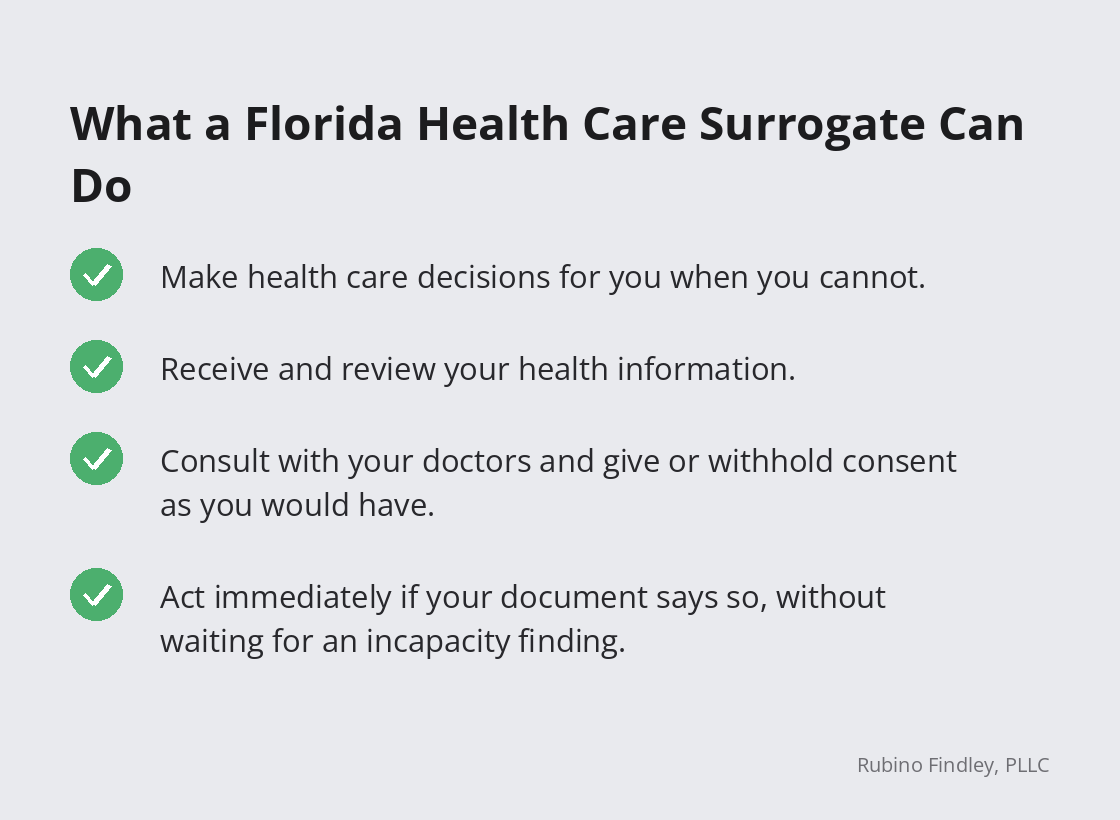
The definition of a health care decision is also broad. It covers informed consent, refusal of consent, or withdrawal of consent to health care, as well as the right of access to the health information a surrogate reasonably needs to make those decisions. In practical terms, your surrogate can talk with your doctors, review your records, and give or withhold consent on your behalf when the law allows.
When the Surrogate’s Authority Begins
Under Florida Statute 765.204, a principal is presumed capable of making health care decisions unless he or she is determined to be incapacitated, and while you have decisionmaking capacity, your wishes control. If your capacity is in question, the primary or attending physician evaluates it and records the conclusion in your medical record. When the evaluating physician has a question about whether you lack capacity, a second physician must also evaluate you.
Florida also allows a more flexible approach. Section 765.202 permits you to state in the document that your surrogate’s authority to receive health information or make health care decisions, or both, is exercisable immediately, without waiting for a determination of incapacity. Many people choose this option so a spouse or adult child can help coordinate care during a hospital stay. Even then, Section 765.204 provides that if you have capacity, your own decisions take precedence over decisions by the surrogate that present a material conflict.
What the Surrogate Must Do
Florida Statute 765.205 sets out the surrogate’s responsibilities. Unless you have expressly limited the authority, your surrogate must consult expeditiously with appropriate health care providers and make only the health care decisions he or she believes you would have made under the circumstances if you were able. If there is no indication of what you would have chosen, the statute allows the surrogate to consider your best interest when deciding whether proposed treatments should be withheld or current treatments withdrawn.
The surrogate may also authorize the release of health information to appropriate persons to ensure continuity of care and may authorize your admission, discharge, or transfer to or from a health care facility. If a court later appoints a guardian, Section 765.205 provides that the surrogate continues to make health care decisions unless the court modifies or revokes that authority.
How to Create a Valid Health Care Surrogate Designation
Florida keeps the signing process simple, but each requirement matters. A designation that fails a formal requirement can leave your family and your doctors uncertain at exactly the moment they need clarity.
Signing and Witness Requirements
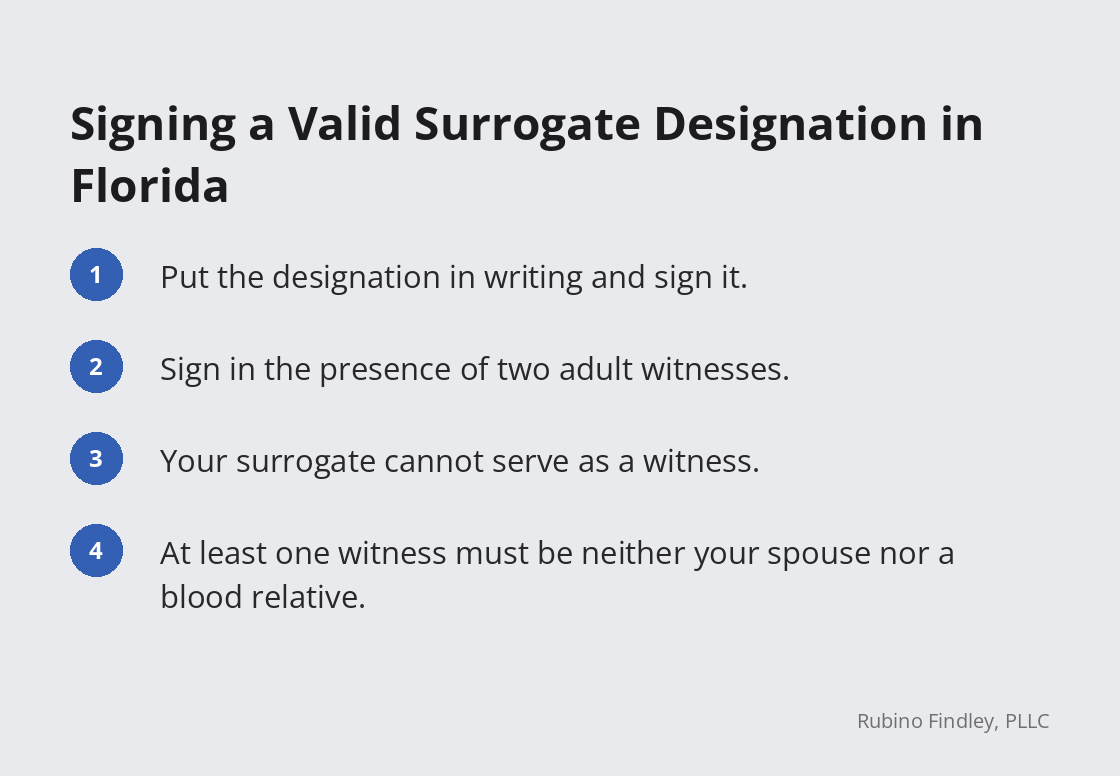
Florida Statute 765.202 requires a written designation to be signed by the principal in the presence of two subscribing adult witnesses. If you are unable to sign, you may, in the presence of the witnesses, direct another person to sign your name. The person you name as surrogate may not act as a witness, and at least one witness must be neither your spouse nor your blood relative.
Section 765.202 calls for two witnesses but does not call for notarization. Section 765.203 provides a suggested form of designation, and the statute states that a designation may, but need not, follow that form. Working from a well-drafted document still matters, because clear language about the scope of authority, timing, and any limits helps providers act on your instructions without hesitation.
Naming an Alternate Surrogate
Section 765.202 allows a designation to name an alternate surrogate, provided the designation is explicit. The alternate may step in if the original surrogate is not willing, able, or reasonably available to perform his or her duties. Failing to name an alternate does not invalidate the designation, but it leaves a gap if your first choice is traveling, ill, or unable to serve.
If neither the surrogate nor the alternate is willing, able, or reasonably available, the same section allows the health care facility to seek the appointment of a proxy under Part IV of Chapter 765. Naming a reliable alternate is one of the simplest ways to keep decisions in the hands of the people you chose.
Keeping Copies Where They Matter
Section 765.202 requires that an exact copy of the instrument be provided to the surrogate. Beyond that statutory requirement, it makes sense to keep the original with your estate planning documents and to share copies with your primary physician and any other physician who treats you regularly. A designation that no one can find in an emergency room is far less useful than one already in your medical file.
If you also sign a living will, Florida Statute 765.302 places responsibility on the principal to notify the primary physician that the living will has been made. A physician or facility that is notified must promptly make the living will or a copy part of your medical records.
Common Mistakes That Undermine a Health Care Surrogate Designation
Most problems with surrogate designations come from documents that are out of date, unclear, or never signed at all. Each of these issues is easy to fix while you are healthy and very difficult to fix once a medical crisis begins.
Assuming Family Can Decide Without a Document
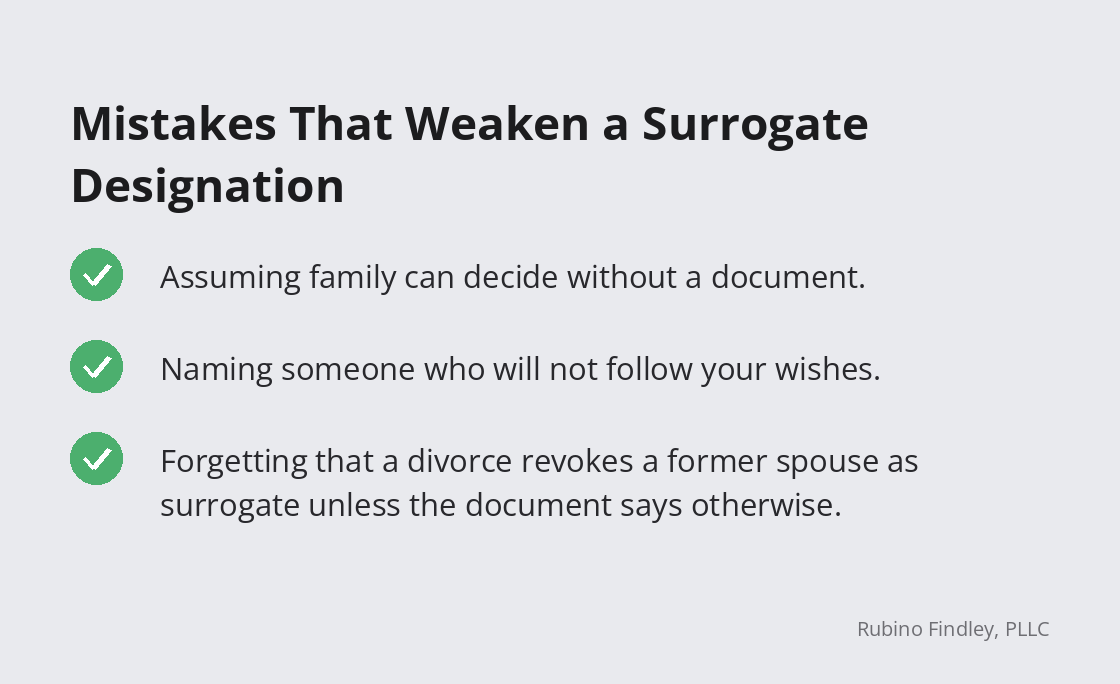
Many people assume a spouse or adult child will automatically make decisions. Florida does provide a fallback, but it is not the same as choosing your own surrogate. Under Florida Statute 765.401, when no surrogate is available, decisions may be made by a proxy in a set order of priority that begins with a judicially appointed guardian and continues with the patient’s spouse, an adult child or a majority of the reasonably available adult children, a parent, and adult siblings. When several adult children must reach a majority decision, disagreements can delay care and strain family relationships.
Choosing the Wrong Person
The best surrogate is not always the closest relative. You need someone who will follow your wishes even if they differ from his or her own views, who can communicate calmly with medical teams, and who will be reachable when needed. Living near Boca Raton or being willing to travel quickly can matter, and so can the person’s ability to handle conflict with other family members. Talk with your choice before you sign, so he or she understands your values and agrees to serve.
Forgetting to Update After Life Changes
Florida Statute 765.104 allows a competent principal to amend or revoke an advance directive at any time, including by a signed, dated writing, physical destruction, an oral expression of intent, or a later directive that is materially different. The same section provides that, unless the directive or the court order says otherwise, a dissolution or annulment of marriage revokes the designation of a former spouse as surrogate. An amendment or revocation becomes effective when it is communicated to the surrogate, health care provider, or health care facility, so share any change promptly.
Your health care documents should work alongside your durable power of attorney, will, and any trust. Reviewing them together after a marriage, divorce, move, or diagnosis helps keep every document consistent.
Final Thoughts
A health care surrogate designation is one of the most practical documents in a Florida estate plan. It names the person who will speak for you, sets out when that authority begins, and gives your doctors clear direction when you cannot communicate your own decisions. Signing it correctly, naming an alternate, and sharing copies are simple steps that prevent uncertainty later.
The right time to put this document in place is while you are healthy and able to think carefully about who should serve. Revisiting it whenever your family or health changes keeps it aligned with your wishes.
If you live in Boca Raton or elsewhere in Palm Beach County and want a health care surrogate designation that fits the rest of your estate plan, contact Rubino Findley, PLLC to speak with our team. We will help you choose the right documents, sign them properly, and move forward with confidence.