




Will Contest Boca Raton: Grounds, Deadlines, and How Florida Courts Decide
Will contest Boca Raton questions usually arise at a painful moment. A parent’s final will leaves out a child who expected to inherit, a new caregiver suddenly appears as the main beneficiary, or a document surfaces that looks nothing like the plan the family heard about for years. Emotions run high, and so do the stakes, because Florida law gives families only a limited window and a specific set of grounds for challenging a will.
At Rubino Findley, PLLC, we help families, beneficiaries, and personal representatives throughout Boca Raton and Palm Beach County understand when a will can be challenged and how to protect a valid estate plan. This guide explains what a will contest actually is under Florida law, how the process and deadlines work, and the mistakes that most often derail a challenge or a defense, so you can move forward with confidence.
What a Will Contest Actually Is in Florida
A will contest is a legal challenge to the validity of all or part of a will. It is not simply a disagreement about whether the distribution feels fair. Florida courts look at whether the document was properly signed and witnessed, whether the person who made it had the capacity to do so, and whether the will reflects that person’s own free choices. Because the contest happens in probate court, the rules of the Florida Probate Code control who may bring it, when it must be filed, and how it is decided.
No Challenge Before Death
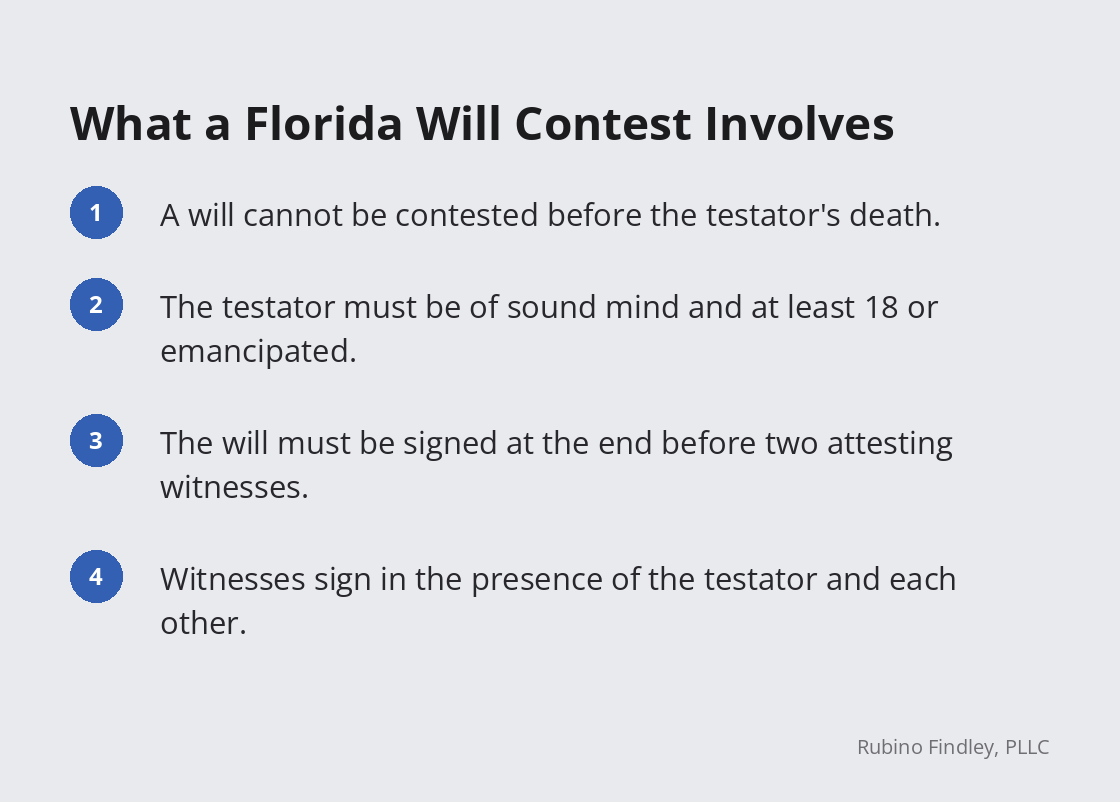
Florida does not allow family members to challenge a will while the person who signed it is still alive. Section 732.518, Florida Statutes, provides that an action to contest the validity of all or part of a will, or the revocation of all or part of a will, may not be commenced before the death of the testator. Disagreements that arise during a parent’s lifetime are better handled through open conversation and careful planning, because the courtroom option only becomes available after death and after the will is offered for probate.
Who Can Make a Valid Will
The first question in many contests is whether the person had the legal ability to make a will at all. Section 732.501 provides that any person who is of sound mind and who is either 18 or more years of age or an emancipated minor may make a will. Claims that a parent lacked capacity often focus on the time the will was signed, which is why medical records, the observations of the witnesses, and the circumstances of the signing can matter so much.
Formal Signing Requirements
Florida is strict about how a will is executed. Under Section 732.502, every will must be in writing, and the testator must sign at the end, or another person must sign the testator’s name at the end in the testator’s presence and by the testator’s direction. The signing, or the testator’s acknowledgment of a prior signature, must be in the presence of at least two attesting witnesses, and those witnesses must sign in the presence of the testator and of each other. A will that misses one of these steps can be vulnerable to challenge, even if everyone agrees about what the person wanted.
How a Will Contest Moves Through Palm Beach County Probate
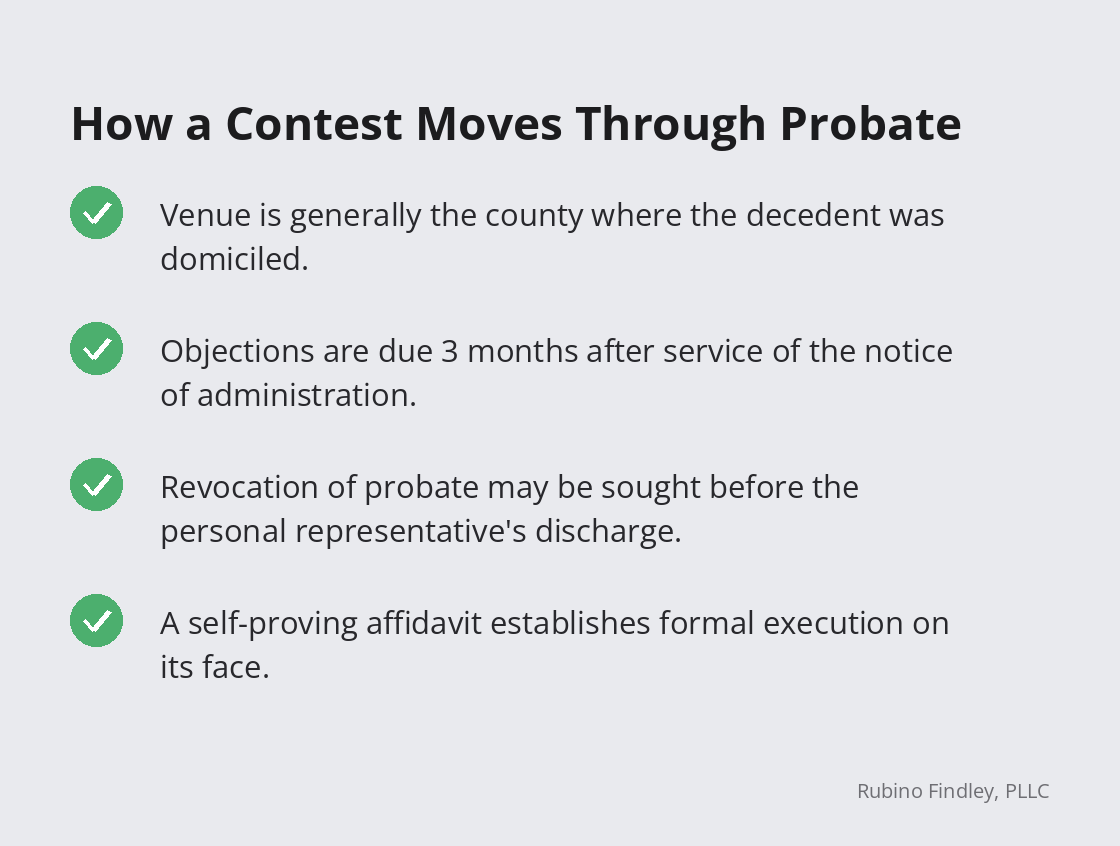
Estates of Boca Raton residents are generally handled in the circuit court for Palm Beach County, which makes up Florida’s Fifteenth Judicial Circuit under Section 26.021. Once a will is admitted to probate there, the clock for most challenges begins to run. Understanding the procedural steps helps beneficiaries and personal representatives respond on time and avoid losing rights simply because a deadline passed.
The Notice of Administration Deadline
The most important deadline in many will contests comes from the notice of administration. Section 733.212 requires the personal representative to promptly serve a copy of the notice on the surviving spouse, beneficiaries, and certain other known persons. An interested person who is served must file any objection that challenges the validity of the will, the venue, or the jurisdiction of the court on or before the date that is three months after the date of service of a copy of the notice on that person. If the objection is not raised in time, the statute provides that those objections are forever barred. That short window is the reason anyone who receives a notice of administration and has concerns about the will should act promptly.
Revocation of Probate Proceedings
A challenge filed after a will has already been admitted usually takes the form of a petition for revocation of probate. Section 733.109 provides that the proceeding is brought in the court having jurisdiction over the administration, and any interested person, including a beneficiary under a prior will, may commence it before final discharge of the personal representative unless barred under Section 733.212 or Section 733.2123. While the petition is pending, the personal representative continues administering the estate, but no distribution may be made to beneficiaries in contravention of the rights of those who would be entitled to the property but for the will. Florida’s Probate Code defines an interested person in Section 731.201 as any person who may reasonably be expected to be affected by the outcome of the particular proceeding involved.
Who Carries the Burden of Proof
Florida divides the burden of proof between the two sides. Under Section 733.107, the person offering the will must first establish its formal execution and attestation. A self-proving affidavit executed under Section 732.503, or an oath of an attesting witness, is admissible and establishes that formal execution on its face. After that, the person contesting the will has the burden of establishing the grounds on which probate is opposed or revocation is sought. Section 732.503 allows a will to be made self-proved through the testator’s acknowledgment and the witnesses’ affidavits before an officer authorized to administer oaths, which is one reason a properly prepared will is much harder to challenge on technical grounds.
What Makes or Breaks a Will Contest
Will contests often turn on facts that were set in motion years before anyone filed a petition. The way the will was prepared, who was present at the signing, and how quickly the family responded after death can all shape the outcome. Knowing the common grounds and pitfalls helps both challengers and defenders evaluate a case realistically.
Fraud, Duress, Mistake, and Undue Influence
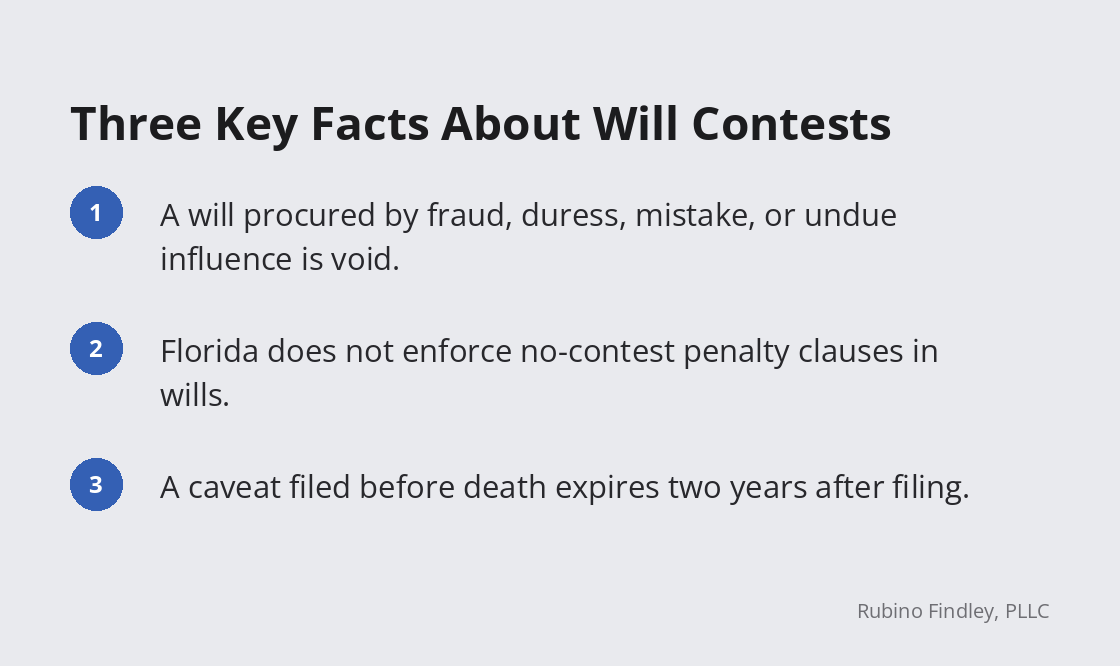
The most common substantive grounds appear in Section 732.5165, which provides that a will is void if its execution is procured by fraud, duress, mistake, or undue influence. If only part of the will was procured that way, only that part is void, and the remainder stays valid if it is not invalid for other reasons. The same statute provides that a revocation procured by any of those means is also void. Undue influence claims frequently involve a caregiver, new friend, or family member who had a close relationship with the testator and played an active role in arranging the new will. Section 733.107 adds that, where the presumption of undue influence applies, it implements public policy against abuse of fiduciary or confidential relationships and shifts the burden of proof.
Relying on a No-Contest Clause
Some people include language in a will that tries to disinherit anyone who challenges it. Florida does not enforce that approach. Section 732.517 provides that a provision in a will purporting to penalize any interested person for contesting the will or instituting other proceedings relating to the estate is unenforceable. Families who plan to protect a will from challenge should focus instead on careful execution, clear documentation of the testator’s intentions, and a self-proving affidavit, rather than counting on a penalty clause that Florida courts will not apply.
Missing the Chance to Be Heard Early
People who expect a dispute sometimes wait too long to get involved. Section 731.110 allows any interested person who is apprehensive that a will may be admitted to probate without that person’s knowledge to file a caveat with the court. When an interested person other than a creditor has filed a caveat, the court may not admit a will to probate or appoint a personal representative until formal notice of the petition for administration has been served on the caveator or the caveator’s designated agent and the caveator has had the opportunity to participate. A caveat filed before death expires two years after filing. Once a will is admitted and the estate moves forward, Section 733.103 makes the probate of a will conclusive in collateral proceedings of its due execution, the testator’s competence, and the absence of fraud, duress, mistake, and undue influence, which is why the challenge must be raised within the probate case itself.
Final Thoughts
A will contest is one of the most stressful experiences a family can face, but Florida law provides a clear framework. Challenges cannot begin before death, they must rest on recognized grounds such as improper execution, lack of capacity, fraud, duress, mistake, or undue influence, and most must be raised within three months after service of the notice of administration. Personal representatives, meanwhile, benefit from a properly executed and self-proved will that shifts the burden to the challenger.
Timing and documentation matter on both sides. Gathering the will, the notice of administration, and any information about how the will was signed, and acting before the deadline passes, gives you far more options than trying to raise concerns after the estate has moved on. If you are a personal representative, our guide to probate administration in Boca Raton explains the duties that continue while a challenge is pending.
If you’re concerned about the validity of a loved one’s will or need to defend an estate plan, contact Rubino Findley, PLLC to speak with our team in Boca Raton. We serve families throughout Palm Beach County and will help you understand your options and move forward with confidence.