




Living Will Boca Raton: How Florida Law Puts Your End-of-Life Wishes in Writing
A living will in Boca Raton gives you a voice in your medical care at the moment you may be unable to speak for yourself. It lets you decide, ahead of time, whether you want life-prolonging procedures continued, withheld, or withdrawn if you face a terminal condition, an end-stage condition, or a persistent vegetative state. Without one, those decisions can fall to family members who are grieving, uncertain, and sometimes in disagreement. Putting your wishes in writing gives you real control and gives the people you love genuine peace of mind.
At Rubino Findley, PLLC, we help individuals and families throughout Palm Beach County build estate plans that cover both their property and their health care wishes so you can move forward with confidence. This guide explains what a Florida living will actually does, how to sign one that will be honored, and the mistakes that most often leave families guessing.
What a Florida Living Will Actually Does
Florida’s health care advance directive laws are found in Chapter 765 of the Florida Statutes. An advance directive is a broad term that includes the designation of a health care surrogate, a living will, and an anatomical gift. A living will is the part of that framework that speaks directly to end-of-life treatment, and it works best when it is coordinated with the rest of your estate plan.
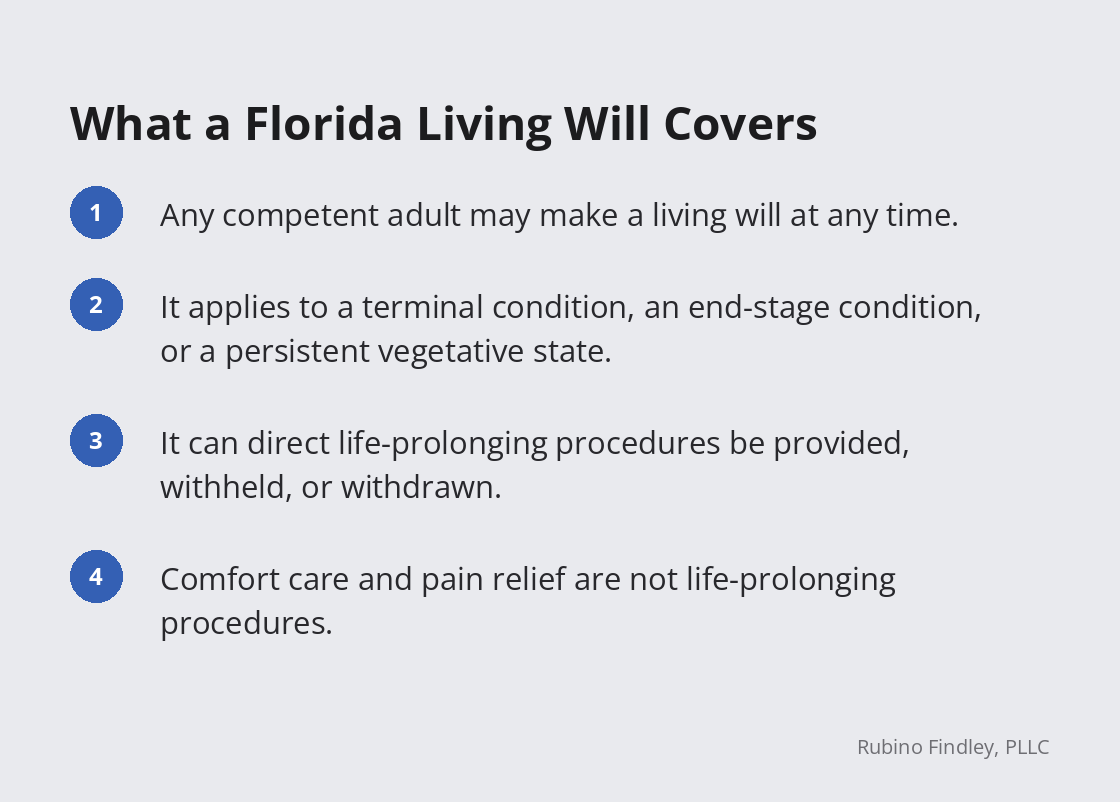
Understanding the specific situations a living will covers, and the treatments it addresses, helps you write instructions that are clear enough to follow.
The Conditions a Living Will Covers
Under Florida Statute 765.302, any competent adult may, at any time, make a living will directing the providing, withholding, or withdrawal of life-prolonging procedures in the event the person has a terminal condition, has an end-stage condition, or is in a persistent vegetative state. Each of those terms has a legal definition in Florida Statute 765.101.
A terminal condition is one caused by injury, disease, or illness from which there is no reasonable medical probability of recovery and which, without treatment, can be expected to cause death. An end-stage condition is an irreversible condition that has resulted in progressively severe and permanent deterioration, for which treatment would be ineffective to a reasonable degree of medical probability. A persistent vegetative state is a permanent and irreversible condition of unconsciousness with no voluntary action or cognitive behavior and an inability to communicate or interact purposefully with the environment.
What Counts as a Life-Prolonging Procedure
Florida Statute 765.101 defines a life-prolonging procedure as any medical procedure, treatment, or intervention, including artificially provided sustenance and hydration, that sustains, restores, or supplants a spontaneous vital function. Because the definition expressly includes artificially provided sustenance and hydration and any intervention that supplants a vital function, it can reach treatments such as feeding tubes and mechanical breathing support, which is why many people choose to address them specifically.
The same definition excludes medication or procedures deemed necessary to provide comfort care or to alleviate pain. A living will that declines life-prolonging procedures does not mean declining comfort. Florida Statute 765.309 also makes clear that nothing in the chapter authorizes mercy killing or euthanasia, and that withholding or withdrawing life-prolonging procedures under the chapter does not constitute a suicide.
How a Living Will Differs From a Health Care Surrogate
A living will states your instructions. A health care surrogate is the person you choose to make health care decisions when you cannot. The two documents work together, and Florida’s suggested living will form in Florida Statute 765.303 even includes a place to name a surrogate to carry out the declaration. Under that same section, failing to designate a surrogate does not invalidate the living will.
Many people sign both documents at the same time so that their surrogate has written guidance to follow. Our article on choosing a health care surrogate in Boca Raton explains how that designation works and what to consider when picking the right person.
How to Sign a Living Will That Will Be Honored in Florida
A living will only helps if it is valid, available, and clear when the moment comes. Florida law sets out simple but specific signing requirements, and it also explains what doctors must confirm before following your instructions.
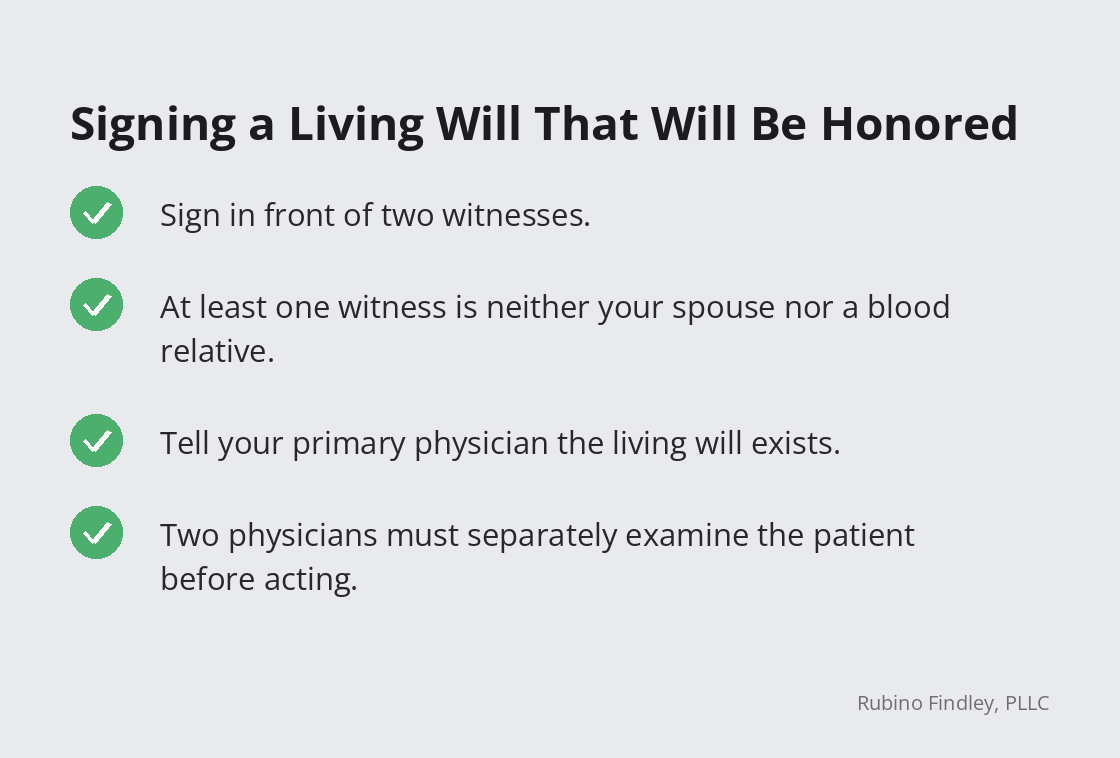
The steps below cover how the document is executed, how it reaches your doctors, and how Florida treats a living will signed somewhere else.
Signing and Witness Requirements
Florida Statute 765.302 requires that a living will be signed by the principal in the presence of two subscribing witnesses, one of whom is neither a spouse nor a blood relative of the principal. If the principal is physically unable to sign, one of the witnesses must sign the principal’s name in the principal’s presence and at the principal’s direction.
Florida provides a suggested form in Florida Statute 765.303, but the statute states that a living will may, but need not, be in that form. Many people prefer a document tailored to their values, medical concerns, and religious beliefs. Under Florida Statute 765.302, a properly executed living will establishes a rebuttable presumption of clear and convincing evidence of the principal’s wishes, which carries real weight if anyone questions what you wanted.
Making Sure Your Doctors Know About It
A living will tucked away in a drawer cannot guide anyone. Florida Statute 765.302 makes it the principal’s responsibility to notify the primary physician that the living will has been made. If the principal is incapacitated when admitted to a health care facility, any other person may notify the physician or facility, and the physician or facility so notified must promptly make the living will or a copy part of the medical records.
Before anyone acts on the document, Florida Statute 765.304 requires a determination that the principal does not have a reasonable medical probability of recovering capacity, that the principal has a terminal condition, an end-stage condition, or is in a persistent vegetative state, and that any limitations or conditions the principal expressed have been considered and satisfied. Under Florida Statute 765.306, the primary physician and at least one other consulting physician must separately examine the patient and document their findings before life-prolonging procedures may be withheld or withdrawn.
Living Wills Signed in Another State
Boca Raton is home to many people who moved from other states and signed their estate planning documents before relocating. Florida Statute 765.112 provides that an advance directive executed in another state in compliance with the law of that state or of Florida is validly executed for purposes of Florida’s advance directive law.
Even so, a document drafted for another state may use different terms or forms that Florida providers find less familiar. Reviewing an older living will after a move to Palm Beach County helps make sure it still reflects your wishes and fits comfortably within Florida’s framework.
Mistakes That Leave Families Guessing
Most living will problems have little to do with the law itself. They come from documents that are outdated, unclear, or unknown to the people who need them. Families often discover these gaps in a hospital hallway, which is the hardest possible time to resolve them.
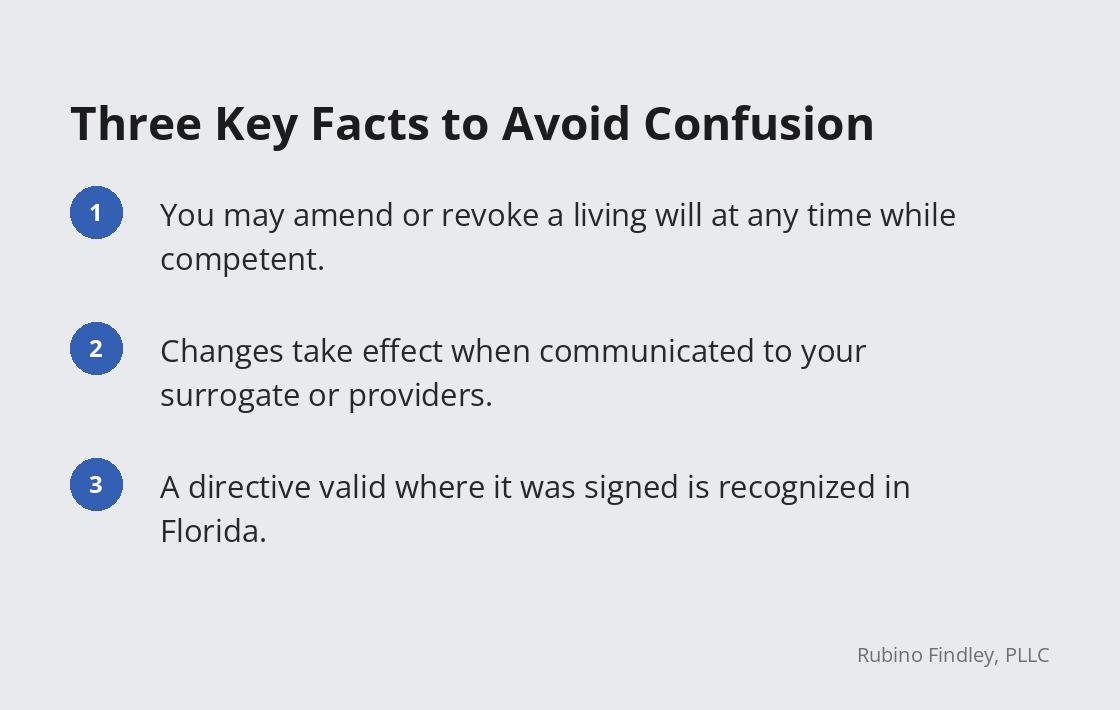
Avoiding the issues below can spare your loved ones painful uncertainty.
Never Updating the Document
Your health, your relationships, and your views about medical care can change over time. Florida Statute 765.104 allows a competent principal to amend or revoke an advance directive at any time by a signed, dated writing, by physically canceling or destroying it or having another do so in the principal’s presence and at the principal’s direction, by an oral expression of intent to amend or revoke, or by signing a later advance directive that is materially different.
Under the same statute, an amendment or revocation is effective when it is communicated to the surrogate, health care provider, or health care facility. Telling your family and doctors about any change, and replacing old copies, keeps everyone working from the same instructions.
Using Vague Language
Instructions such as “no heroic measures” can mean very different things to different people. When a living will is ambiguous, disagreements can follow. Florida Statute 765.105 allows the patient’s family, the health care facility, the primary physician, or another interested person to seek expedited judicial review of a surrogate’s or proxy’s decision if, among other reasons, they believe the advance directive is ambiguous or the patient changed his or her mind after signing it.
Clear, specific instructions about treatments you would or would not want reduce the chance that your family ends up in that position. Talking through your wishes with your surrogate and loved ones adds another layer of clarity.
Treating a Living Will as a Complete Plan
A living will addresses end-of-life medical treatment, but it does not handle your finances, your property, or decisions outside the specific conditions it covers. A durable power of attorney, a health care surrogate designation, a will, and in many cases a trust each play their own role. Our guide to Palm Beach estate planning explains how these documents fit together.
When the documents are prepared together, they can support one another rather than leave gaps. Coordinating them also makes it easier for your family to find everything they need in one place.
Final Thoughts
A living will in Boca Raton is one of the most personal documents in your estate plan. It lets you decide how you want to be cared for at the end of life, spares your family from guessing, and carries legal weight under Florida law when it is signed and witnessed correctly.
The key steps are straightforward: understand the conditions your living will covers, sign it with the proper witnesses, make sure your doctors and surrogate know about it, and review it as your life changes. Taking those steps now protects both you and the people you love.
If you are ready to put your health care wishes in writing, contact Rubino Findley, PLLC to speak with our team in Boca Raton. We help clients throughout Palm Beach County create living wills and complete estate plans that reflect what matters most to them.