




Choosing a Florida Probate Attorney: Your Guide to Smooth Proceedings
Probate can feel overwhelming when you’re grieving and managing an estate at the same time. The paperwork alone is substantial, and Florida’s probate laws add another layer of complexity that most people don’t understand.
We at Rubino Findley, PLLC know that hiring a Florida probate attorney makes the difference between a smooth process and costly mistakes. This guide walks you through what to look for and how the right legal support protects your family’s interests.
Why You Need Legal Guidance for Florida Probate
Florida Law Requires Attorney Representation
Florida probate law mandates attorney representation for Formal Administration, the most common probate pathway. This isn’t optional-it’s a legal requirement that protects both the estate and the Personal Representative from liability. The probate process involves navigating multiple court filings, managing creditor claims within strict timelines, and handling asset valuations that directly impact what your family receives. Without proper legal guidance, estates commonly face delays that stretch from the standard six to twelve months into years.
Understanding the Financial Impact
Court filing fees alone run $300 to $400 depending on the county, but attorney fees under Florida Statute 733.6171 scale with estate value-ranging from $1,500 for estates under $40,000 to percentages that can reach 3% for larger estates. A misstep in paperwork, missed deadlines, or improper creditor notice can reopen the entire process, compounding costs exponentially. Procedural errors that a knowledgeable attorney would have prevented from the start often cost families thousands of dollars and months of additional time.
How Personal Representatives Fail Without Counsel
The most damaging mistakes occur when Personal Representatives attempt probate without counsel. Missing the ten-day deadline to file the will with the Clerk’s office creates immediate complications. Failing to publish proper notice to creditors within the required timeframe can invalidate creditor claims but also expose the estate to future liability. Asset inventories submitted incorrectly to the court trigger judicial scrutiny and additional filings.
Creditor claims often go uncontested when a Personal Representative lacks knowledge of Florida’s dispute mechanisms, resulting in the estate paying claims it could have challenged. Disputes among heirs escalate into litigation when proper communication and documentation aren’t established early. Without litigation experience, a Personal Representative cannot effectively protect the estate’s interests.
What Proper Legal Guidance Prevents
A capable probate attorney prevents these outcomes by managing the entire administration sequence, resolving creditor disputes before they become courtroom battles, and ensuring your family receives distributions on schedule rather than waiting months longer while legal problems get sorted out. The right attorney handles the complexity so you can focus on what matters most-honoring your loved one’s memory and moving forward.
Understanding these risks sets the stage for knowing exactly what qualities to look for in a probate attorney.
What to Look for in a Probate Attorney
Local Experience and Florida Probate Knowledge
Experience with Florida probate law and local court systems separates attorneys who navigate Palm Beach County efficiently from those who struggle through procedural requirements. Ask potential attorneys directly how many years they have practiced probate law in Florida, not estate planning generally. An attorney with 15+ years focused specifically on probate administration understands the nuances of Florida Statute 733 for Formal Administration, knows how judges in your county interpret creditor notice requirements, and predicts which procedural issues will arise before they become problems.
Local familiarity matters significantly because court procedures vary by county, and judges hold individual preferences about how they want orders submitted. The 15th Judicial Circuit’s Online Scheduling System, for example, requires proposed orders submitted through that portal only-not by email or standard e-filing. An attorney unfamiliar with this requirement will file incorrectly and waste weeks waiting for rejection.
Litigation Experience and Case History
When you speak with candidates, ask them to describe their experience with contested creditor claims, will disputes, and situations where heirs disagreed about asset distribution. Attorneys who have handled litigation related to probate protect your estate when complications arise rather than referring you elsewhere mid-process.
A track record handling cases similar to yours-whether your estate is under $75,000 and qualifies for Summary Administration or exceeds $900,000 and involves complex asset valuations-matters enormously. Fee structures and timelines differ significantly based on estate size and complexity, so prior experience with estates like yours indicates how smoothly your administration will proceed.
Fee Transparency and Cost Breakdown
Fee transparency is non-negotiable, and you should insist on a written engagement letter that itemizes exactly what you’re paying for before any work starts. Under Florida Statute 733.6171, attorney fees follow statutory guidelines: $1,500 for estates under $40,000, $2,250 for estates $40,000 to $70,000, $3,000 for estates $70,000 to $100,000, and 3% of value for estates $100,000 to $900,000. Some attorneys charge hourly rates instead, typically $200 to $400 per hour depending on experience and location.
Before committing, ask the attorney to estimate the total cost including court filing fees (usually $300 to $400), publication costs for creditor notice, appraisal fees if required, and any miscellaneous expenses. Request clarity on what happens if the estate becomes contested-does the hourly rate increase, or does litigation fall outside the original fee agreement?
Communication Style and Responsiveness
Communication preferences matter equally to legal knowledge. Establish upfront how often you will receive updates, whether the attorney will contact you or you must initiate contact, and which communication methods they prefer. Some attorneys provide quarterly updates automatically; others respond only when you call.
During your initial consultation, assess whether the attorney listens to your concerns or rushes through the meeting. A probate attorney should ask detailed questions about potential heirs, creditor situations, and whether disputes might arise-not simply quote fees and move forward. The attorney you select will guide your family through months of administration, so their willingness to communicate clearly and address your specific situation determines whether the process feels manageable or stressful.
With these qualities in mind, you’re ready to understand how the right attorney actually streamlines your probate administration from start to finish.
How a Probate Attorney in Boca Raton Streamlines Administration
Managing Court Filings and Deadlines
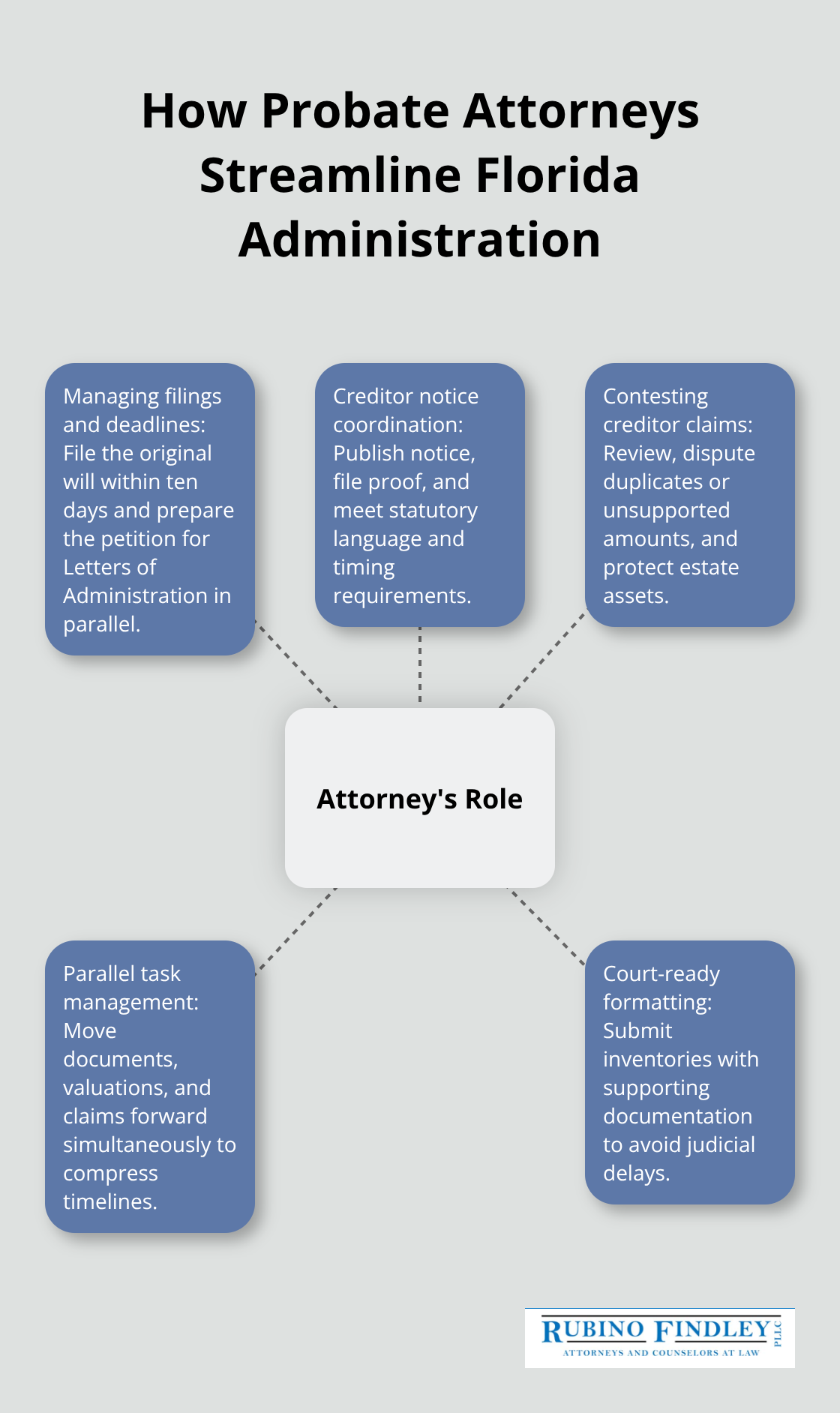
A probate attorney eliminates procedural bottlenecks that delay most estates. The ten-day deadline to file the original will with the Clerk’s Probate Division exists in every Florida probate case, and missing it creates immediate complications that cascade through the entire process. Your attorney files this document by hand delivery or mail while simultaneously preparing the petition for Letters of Administration, which typically issues within one to four weeks. During this same period, the attorney publishes notice to creditors in a local newspaper and files proof of publication with the Clerk-a task requiring coordination across multiple vendors and strict adherence to Florida’s statutory language. Without legal guidance, Personal Representatives often miss publication deadlines or use incorrect legal descriptions, forcing the court to reject filings and restart the creditor notice period. A qualified attorney prevents these delays through parallel management of the entire sequence rather than sequential steps, compressing weeks of potential delays into an organized timeline.
Contesting Creditor Claims and Protecting Assets
Creditor claims represent the second major area where attorneys prevent costly errors. Florida law grants creditors four months from publication to file claims against the estate, and the Personal Representative must evaluate each claim within a specific timeframe to accept or reject it. An attorney reviews every creditor claim against the estate’s records and challenges questionable claims-medical bills submitted twice, creditors without valid documentation, or claims that exceed the actual debt. Probate attorneys routinely save clients thousands by contesting inflated claims that an unrepresented Personal Representative would have paid without question. When disputes arise among heirs or beneficiaries disagree about asset valuations, the attorney coordinates mediation or, if necessary, litigation to resolve conflicts before they derail the entire administration.
Accelerating the Administration Timeline
Formal Administration typically requires six to twelve months because of the mandatory 90-day creditor notice period, but an attorney ensures the estate uses every available day to gather documents, valuate assets, and address claims simultaneously rather than waiting for one step to finish before starting the next. Summary Administration for estates under $75,000 often finishes in two to three months, but only when an attorney files the correct affidavit and avoids the common mistake of attempting Summary Administration when the estate actually exceeds the statutory threshold. The difference between a six-month probate and a twelve-month probate often comes down to whether the Personal Representative’s attorney anticipated which court documents the judge would request and prepared them proactively rather than reactively.
Formatting Documents to Court Standards
Asset inventories submitted to the court without proper supporting documentation trigger judicial scrutiny and demand additional appraisals or valuations. An experienced probate attorney formats inventories to match the court’s expectations and includes the documentation necessary to avoid follow-up questions that extend timelines unnecessarily.
Fee structures under Florida Statute 733.6171 reward efficiency-an attorney handling a $500,000 estate earns 3% regardless of whether administration takes six months or eighteen months, creating a direct financial incentive to resolve the estate promptly rather than dragging out the process.
Final Thoughts
The right Florida probate attorney combines deep knowledge of Palm Beach County court procedures with a genuine commitment to protecting your family’s interests. Look for someone with 15+ years focused specifically on probate administration in Florida, not a generalist who handles probate occasionally. Litigation experience matters because contested creditor claims and heir disputes happen more often than people expect, and you need an attorney who can resolve these conflicts without abandoning your case midway through administration.
Fee transparency separates trustworthy attorneys from those hiding costs. Insist on a written engagement that breaks down court filing fees, publication costs, appraisal expenses, and attorney compensation before any work starts. Communication style determines whether probate feels manageable or stressful over the months ahead, so choose someone who listens to your concerns and provides regular updates without requiring you to chase them down.
Working with a local Boca Raton professional gives you an enormous advantage because they understand how judges in your county interpret Florida Statute 733, know the Clerk’s office procedures, and navigate the 15th Judicial Circuit’s Online Scheduling System without costly filing errors. Your family deserves someone who manages the complexity so you can focus on honoring your loved one’s memory. We at Rubino Findley, PLLC help clients throughout Palm Beach County with probate administration, estate planning, and probate litigation-contact us to schedule your free consultation and discover how we can guide your family through this process with confidence.