



Homestead Protection Boca Raton: How Florida Law Protects Your Home and Limits Who Can Inherit It
Homestead protection in Boca Raton is one of the most valuable legal benefits a Florida homeowner has, and it is also one of the most misunderstood. Many homeowners know that Florida protects the family home from creditors, yet few understand how far the protection reaches, what it does not cover, or how it limits what a homeowner can leave to family members. Understanding these rules is a key part of any sound estate plan in Palm Beach County.
At Rubino Findley, PLLC, we help Boca Raton families protect their homes and plan for the future so you can move forward with confidence. This guide explains the Florida Constitution’s homestead provisions, what the protection means for creditors, how homestead passes at death, and the mistakes that can undo a carefully built plan.
How Homestead Protection in Boca Raton Actually Works
Florida homestead protection comes from Article X, section 4 of the Florida Constitution. It is not a program you sign up for, and it is not the same thing as the annual exemption on a county property bill. It is a constitutional protection that attaches to a qualifying home owned by a natural person, and it has consequences both during life and after death.
Protection From Forced Sale
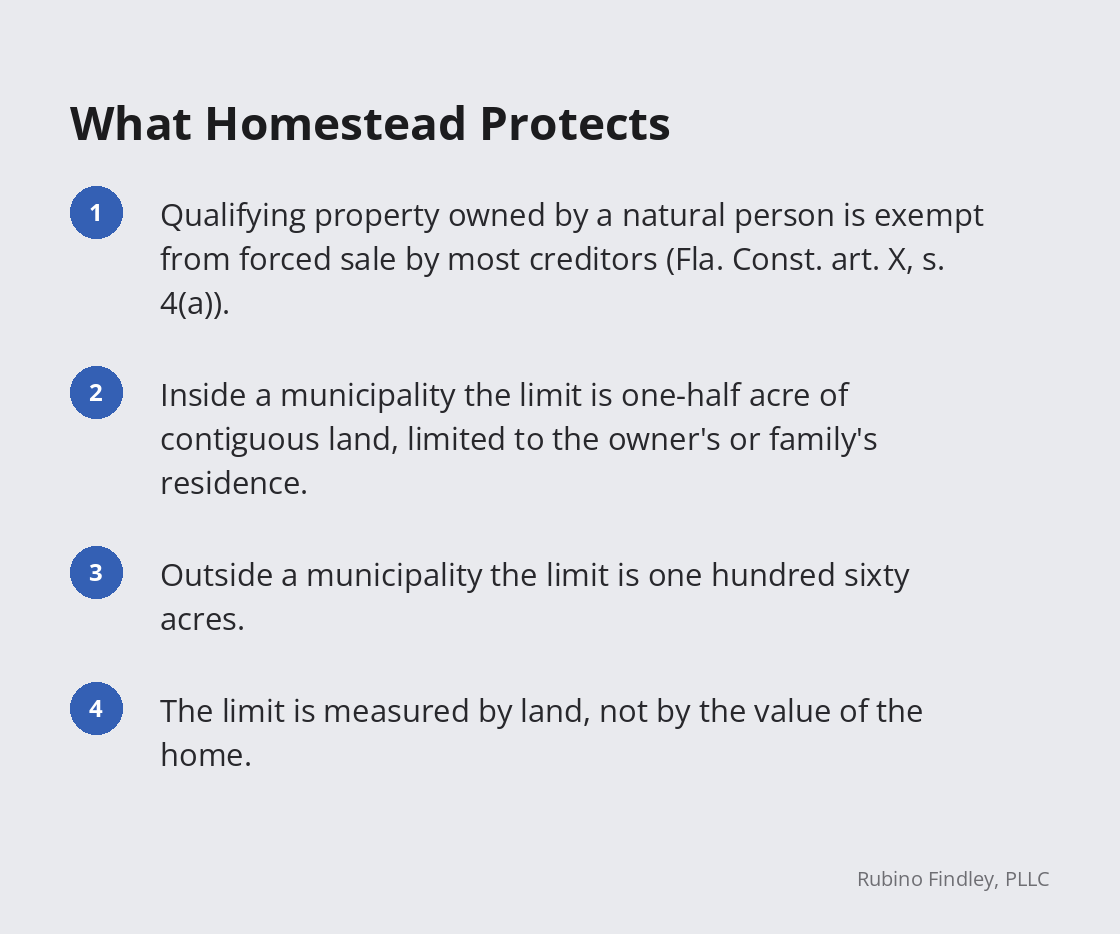
The Constitution provides that certain property owned by a natural person is exempt from forced sale under process of any court, and that no judgment, decree, or execution is a lien on it. In practical terms, if someone obtains a money judgment against a Boca Raton homeowner, that creditor generally cannot force the sale of a protected homestead to collect the debt. This is a protection of the property itself, and it does not turn on the home’s value.
Limits on Land, Not Value
Article X, section 4(a)(1) measures the protection by land rather than by value. A homestead located outside a municipality is protected to the extent of one hundred sixty acres of contiguous land and the improvements on it. A homestead located within a municipality, which covers most of Boca Raton, is protected to the extent of one-half acre of contiguous land, and the exemption is limited to the residence of the owner or the owner’s family. A homeowner with a larger lot should ask how the limit applies to the particular property.
Exceptions the Constitution Lists
The protection is broad but not absolute. The Constitution says the exemption applies except for certain listed obligations. Among them are obligations contracted for the purchase, improvement, or repair of the home, and obligations contracted for house, field, or other labor performed on the realty. A lender who financed the purchase of the home, or a contractor who was hired to improve or repair it, is therefore treated differently from a creditor who simply holds a judgment on an unrelated debt.
A Written Claim of Homestead
Section 222.01 of the Florida Statutes provides that a natural person residing in Florida who wants to rely on the homestead provisions may make a written statement describing the property claimed as exempt and declaring that it is the person’s homestead. The statement must be signed by the person making it and recorded in the circuit court. The protection does not depend on that filing, but recording a statement can be a useful way to put a creditor or a buyer on notice.
What Happens to a Boca Raton Homestead When the Owner Dies
The same rules that protect a home from creditors also restrict what an owner may do with it at death. This surprises many families, because owners of other property can usually leave it to anyone they choose. Homestead is different, and the difference is written into the Constitution itself.
Limits on Leaving Your Home by Will or Trust
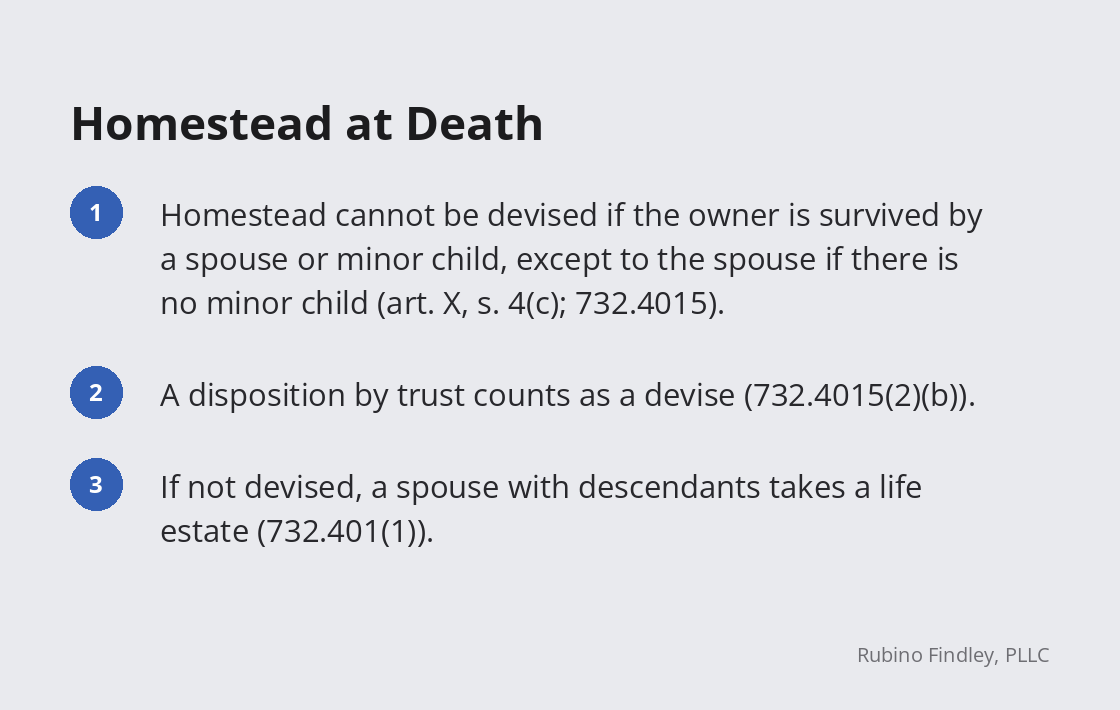
Article X, section 4(c) provides that the homestead shall not be subject to devise if the owner is survived by a spouse or minor child, except that the homestead may be devised to the owner’s spouse if there is no minor child. Section 732.4015(1) of the Florida Statutes repeats that rule. Under section 732.4015(2), the word devise includes a disposition by trust of that portion of the trust estate that would be the grantor’s homestead if titled in the grantor’s name. In other words, placing a home into a living trust does not avoid the restriction.
Protection for a Surviving Spouse or Heirs
Article X, section 4(b) states that the exemptions inure to the surviving spouse or heirs of the owner. This means the protection from creditors can continue for the people who inherit a qualifying homestead. Families who plan carefully can use this feature to keep a home in the family without it being reached by the owner’s creditors after death.
When the Home Is Not Devised
If the homestead is not devised as the law and the Constitution allow, section 732.401(1) provides that it descends in the same manner as other intestate property. But if the decedent is survived by a spouse and one or more descendants, the surviving spouse takes a life estate in the homestead, with a vested remainder to the descendants in being at the time of the decedent’s death. A life estate allows the spouse to live in the home but not to sell it outright, which can create friction in blended families.
The Surviving Spouse’s Election
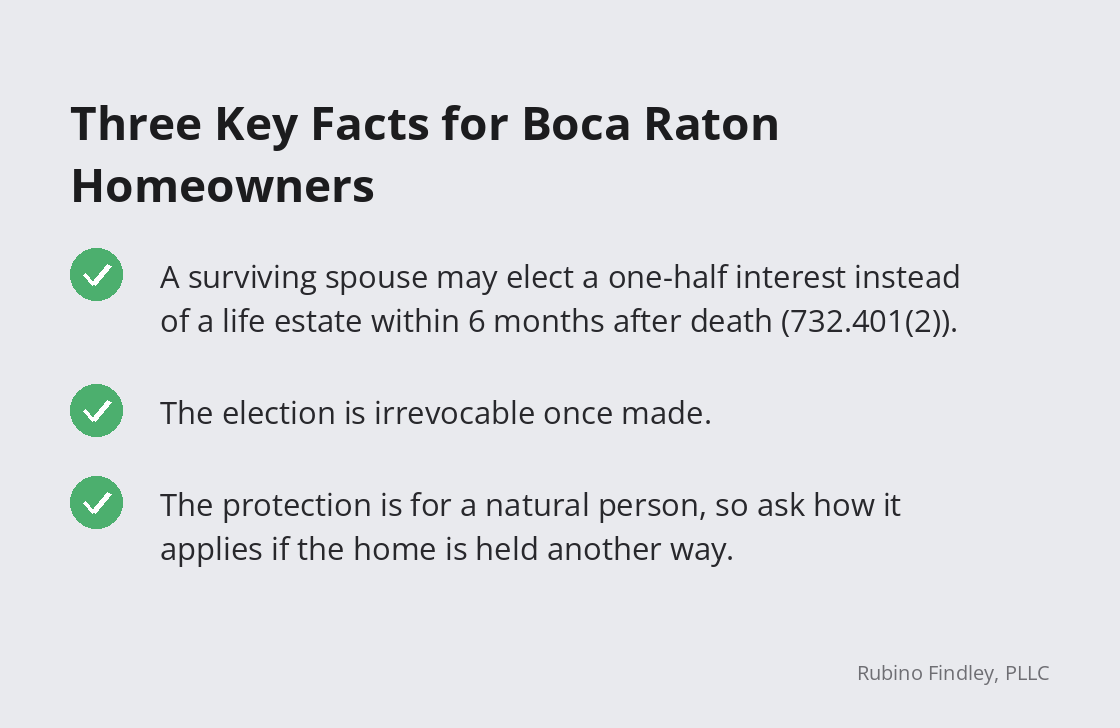
Section 732.401(2) allows the surviving spouse, in place of a life estate, to elect to take an undivided one-half interest in the homestead as a tenant in common, with the remaining one-half interest vesting in the decedent’s descendants. Under section 732.401(2)(b), the election must be made within 6 months after the decedent’s death and during the surviving spouse’s lifetime, and once made, section 732.401(2)(d) provides that it is irrevocable. Because the deadline is short and the choice is permanent, a surviving spouse should seek guidance promptly.
Common Homestead Mistakes in Boca Raton Estate Plans
Most homestead problems arise from assumptions rather than from bad intentions. A family may assume a trust solves everything, or may overlook how a second marriage changes the picture. Careful planning avoids surprises.
Assuming a Trust Avoids the Devise Rules
Because section 732.4015(2)(b) treats a disposition by trust of homestead property as a devise, a trust cannot be used to leave a protected home to a person the Constitution does not allow. A plan that tries to do so can end up in court, where the restriction will be applied. The solution is to design the plan around the rule, using tools that are consistent with it, rather than hoping the issue will not arise.
Overlooking a Second Marriage or Minor Children
The devise restriction is triggered by a surviving spouse or a minor child. A homeowner in a second marriage with children from a first marriage may want the home to go to those children, but the Constitution limits what can be done. Boca Raton families in this situation should review the title, the marriage, and the intended beneficiaries well before a crisis. Planning options exist, but they must fit within the rules.
Transferring a Home Without Thinking Through the Consequences
Article X, section 4(c) allows the owner of homestead real estate, joined by the spouse if married, to alienate the homestead by mortgage, sale, or gift. That flexibility is valuable, but a transfer changes ownership, and it may affect creditor protection, a surviving spouse’s rights, and future planning. Before signing a deed, talk through how the transfer works with the rest of your plan.
Waiting Too Long to Review Your Plan
Marriages, births, deaths, and moves all change how homestead rules apply. A plan prepared years ago may no longer fit your family. Review your deeds, your will or trust, and your beneficiary choices when your life changes, so that the home goes where you want it to go.
Final Thoughts
Homestead is a constitutional protection that shields a qualifying Florida home from forced sale by most creditors, and it carries rules about who can inherit the home. The protection is measured by land, not value, it is subject to listed exceptions, and it affects what a homeowner may do by will or trust when a spouse or minor child survives. A clear understanding of these rules helps Boca Raton homeowners avoid unwelcome surprises and protect the people they love.
If you own a home in Boca Raton or elsewhere in Palm Beach County and want to make sure your estate plan works with Florida’s homestead rules, contact Rubino Findley, PLLC to speak with our team. We will review your situation and help you build a plan with confidence.