




How to Handle Summary Probate Administration in Florida
Summary probate administration in Florida offers a faster, simpler path for settling smaller estates. This streamlined process can save families time and money compared to traditional probate.
At Rubino Findley, PLLC, we serve Palm Beach County, Florida, and help families navigate this process correctly. This guide walks you through the steps, requirements, and common pitfalls to avoid.
What Summary Probate Actually Means
Summary probate administration is Florida’s streamlined process for closing smaller estates without the full court supervision required in formal probate. According to Florida Statutes Section 735.201, you can use summary administration if the estate’s total assets are $75,000 or less, or if the person died more than two years ago regardless of asset value. Homestead property and exempt assets like household furnishings up to $20,000 and two motor vehicles don’t count toward that $75,000 threshold, which means your estate might qualify even with valuable real estate. The process skips appointing a personal representative and eliminates the formal creditor claims period, allowing assets to move to beneficiaries in roughly one to two months instead of the six to eighteen months typical formal probate requires.
When Your Estate Qualifies
The eligibility rules are straightforward but require careful attention. If the decedent died more than two years ago, summary administration works regardless of how much the estate is worth-the two-year mark automatically bars creditors from filing claims under Florida law. For more recent deaths, you face a limit of estates under $75,000 in non-exempt assets. Exempt property passing to a spouse or children, including the homestead residence, vehicles, and household items, gets excluded from this calculation. Common complications that push estates into formal probate include unpaid creditors within the two-year window, invalid will language, and beneficiary disputes. Families often attempt summary administration only to discover they’ve missed eligibility requirements or failed to properly document creditor status, forcing them to restart the process in formal probate at significantly higher cost.
How Summary Probate Differs from Formal Administration
The most critical difference is the absence of a personal representative and letters of administration in summary probate. In formal probate, banks and financial institutions demand letters of administration before releasing any funds, creating gatekeeping delays. Summary probate bypasses this entirely-the court issues an order, and beneficiaries can claim assets directly once distribution receives approval. Costs reflect this simplification: summary administration typically runs $400 to $500 in court fees plus attorney charges, while formal probate frequently exceeds $1,500 to $3,000 depending on estate complexity and attorney fee structures. Filing costs in Palm Beach County average around $346, though this varies by county.
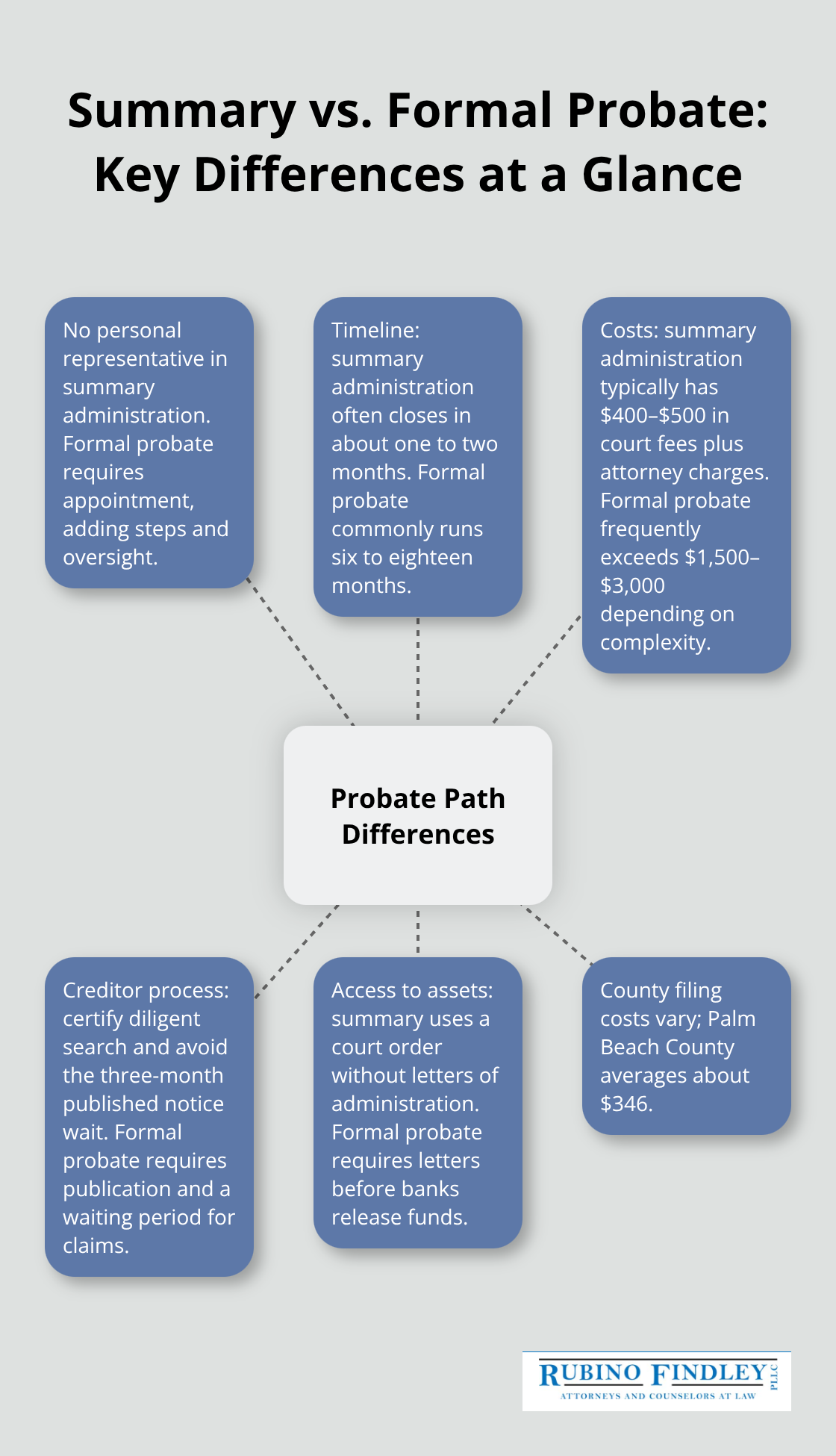
The creditor notification process also diverges sharply; summary probate requires you to certify that you’ve searched diligently for creditors and either bar claims or pay legitimate debts, but you avoid the published notices and three-month waiting period mandatory in formal probate.
Why Creditor Status Matters Most
Getting creditor status right from the start determines whether summary administration succeeds or fails. If creditors emerge after summary administration closes, the process is essentially locked-you cannot reopen it. This finality makes the initial creditor search and documentation (whether creditors exist, whether they’re barred by the two-year rule, or whether debts require payment) the linchpin of the entire procedure. Mishandling this step forces families to abandon summary administration and convert to formal probate, multiplying both time and expense. The next section walks you through the specific documents and steps required to file summary administration correctly and avoid these costly mistakes.
Steps to Complete Summary Probate Administration
Preparing Your Petition for Summary Administration
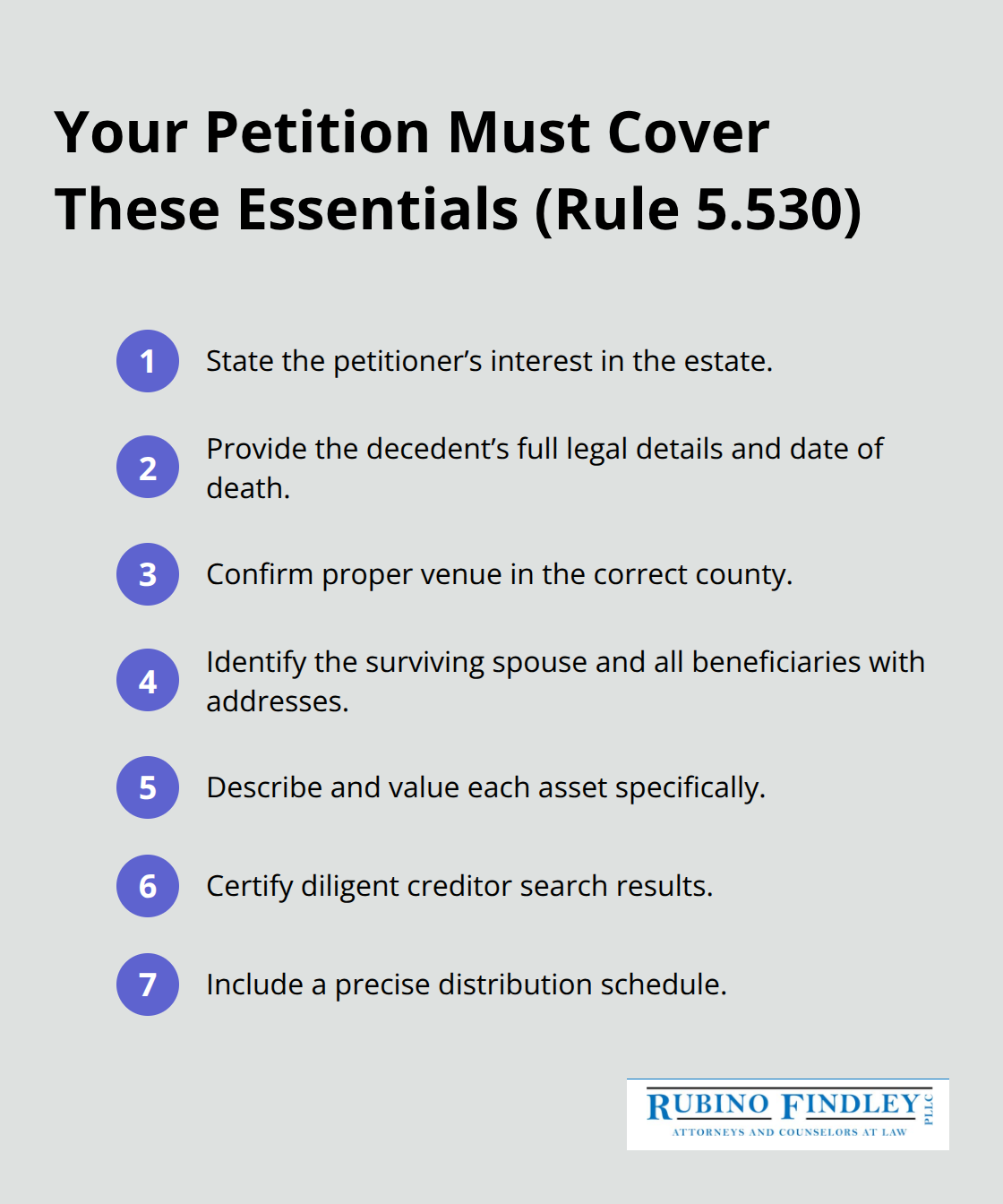
The petition for summary administration is the single document that drives the entire process, and accuracy prevents costly delays or forced conversions to formal probate. Florida Probate Rule 5.530 requires you to include specific information: the petitioner’s interests in the estate, the decedent’s full details and date of death, proper venue in the correct county, names and addresses of the surviving spouse and all beneficiaries, a detailed description and valuation of every asset, your certification of diligent creditor search results, and a proposed distribution schedule showing exactly how assets will be divided. The petition must certify whether creditors are barred by the two-year rule or whether debts will be paid from estate funds before distribution. Vague language here invites the court to reject your filing and demand revisions.
In Palm Beach County, filing fees average around $346, though you should confirm the exact amount with the Clerk of Court before submission. If homestead real estate passes to a spouse or lineal heirs, you must file a separate Petition to Determine Homestead Status simultaneously; the court then issues an Order Determining Homestead Status that protects the property from creditor claims and streamlines its transfer. Similarly, if exempt property like household furnishings up to $20,000 passes to a spouse or children, file a Petition to Determine Exempt Property so the court formally designates these assets as protected from general creditors. Many families skip these companion petitions thinking they’re optional, then face months of delay when the court refuses to distribute assets without them.
File the documents with the Probate Division of the circuit court in the county where the decedent lived at death; if the decedent owned real estate in multiple counties, file in the county where the primary residence was located. Proposed orders must go through the court’s Online Scheduling System rather than by mail, email, or in person-this procedural requirement trips up self-represented filers regularly, so confirm your local court’s submission rules before drafting.
Managing Creditor Notification Requirements
Creditor notification in summary administration works differently than formal probate, and this difference creates the biggest practical advantage of the streamlined process. If the decedent died more than two years ago, creditors are automatically barred from filing claims under Florida law-no notices required, no waiting period, no exceptions. For deaths within the two-year window, you have two paths: either file a Notice to Creditors in a newspaper with general circulation in the county and wait thirty days for claims, or certify in your petition that no creditors exist and that all known debts will be paid.
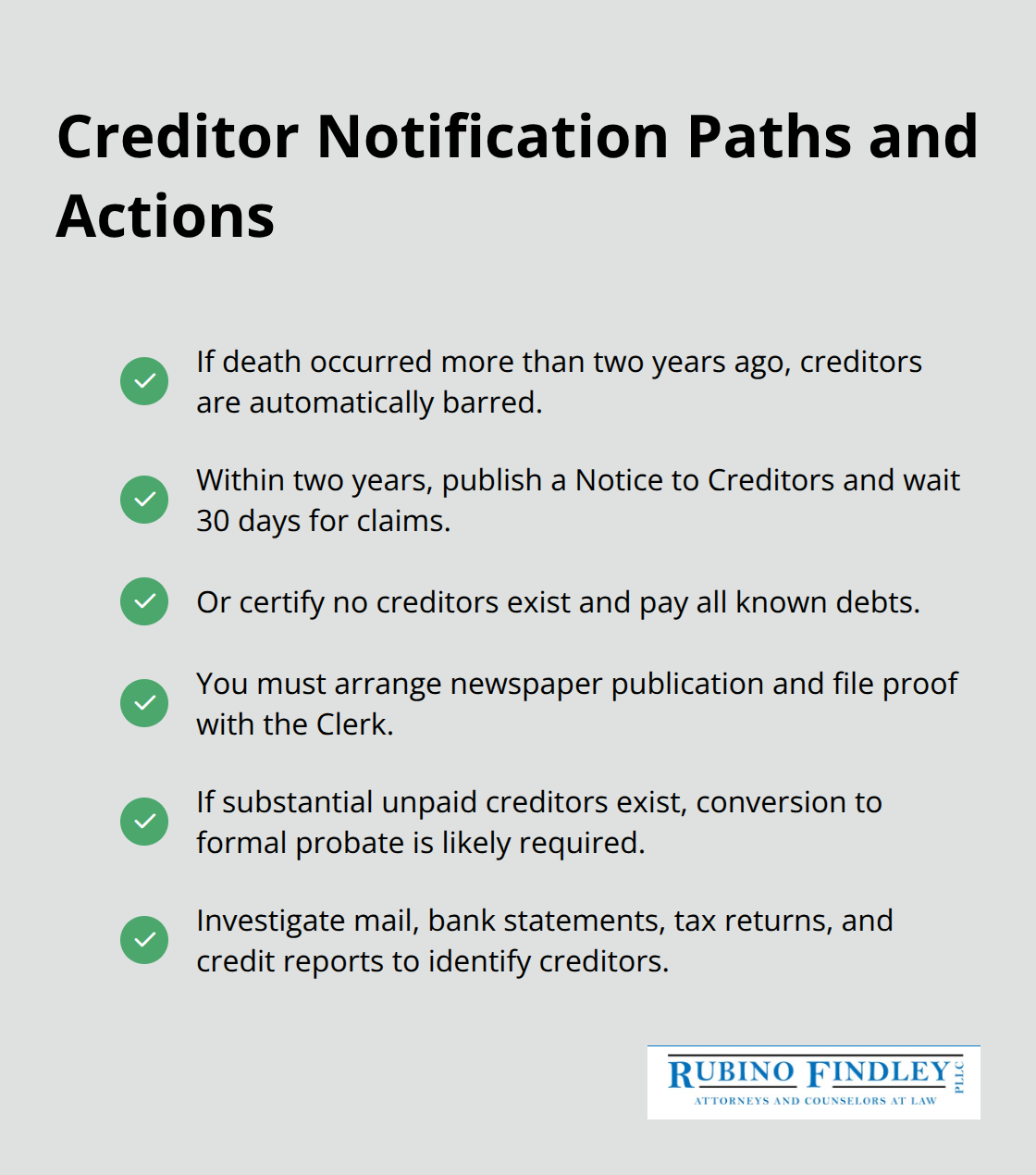
The newspaper notice route adds three to four weeks to your timeline and requires you to arrange publication directly with the newspaper, then file a proof of publication with the Clerk-courts do not handle this publication for you. If substantial creditors exist and you cannot pay them from estate assets, converting to formal probate becomes unavoidable because summary administration cannot remain open to process ongoing creditor claims. This is why the initial creditor search matters so intensely: you must actually investigate whether creditors exist by reviewing the decedent’s mail, financial records, tax returns, and credit reports rather than simply assuming none exist.
Obtaining Court Approval and Distributing Assets
Once the court approves your petition and issues an Order for Summary Administration, asset distribution follows relatively quickly. The court’s order authorizes the transfer of assets to beneficiaries named in the petition without requiring letters of administration or personal representative appointment. Beneficiaries can then claim bank accounts, investment accounts, and personal property directly by presenting the court’s order to financial institutions. Real estate transfers through a new deed recorded in the Official Records, with the homestead order attached to establish title.
The entire process from filing to final distribution typically closes within one to two months if creditor issues are resolved cleanly and no complications emerge. This speed makes summary administration genuinely faster than formal probate’s six to eighteen month timeline. However, common complications can derail even well-prepared petitions-and the next section shows you exactly which mistakes families make most often and how to avoid them.
Common Mistakes That Kill Summary Probate Applications
Miscalculating the $75,000 Asset Threshold
The most common reason summary probate fails is misunderstanding what counts toward the $75,000 asset threshold. Families routinely include homestead real estate in their calculation, assume the threshold applies to gross estate value, or forget to subtract exempt property like household furnishings and vehicles. Florida Statutes Section 735.201 explicitly excludes homestead property and exempt assets from the threshold calculation, meaning an estate with a $250,000 home, two vehicles, and $60,000 in liquid assets qualifies for summary administration because only the $60,000 counts. This distinction matters enormously-many families abandon summary administration unnecessarily and convert to formal probate, multiplying both time and expense.
Failing to Document Creditor Status Properly
The second major error involves creditor status documentation. Families either skip the diligent creditor search entirely, assuming no creditors exist without investigating bank statements or credit reports, or they certify that creditors are barred by the two-year rule when the death occurred within two years and creditors actually exist. When creditors later surface and file claims, the summary administration order cannot be reopened, forcing conversion to formal probate with all its delays and expense. The petition must certify whether creditors are barred by the two-year rule or whether debts will be paid from estate funds before distribution. Vague language here invites rejection and demands for revisions.
Omitting Required Companion Petitions
A third critical mistake occurs when petitioners file incomplete companion petitions. If homestead real estate transfers to a spouse or lineal heirs, the Petition to Determine Homestead Status must accompany the main petition, and if exempt property like vehicles or household items pass to eligible beneficiaries, the Petition to Determine Exempt Property must also be filed. Courts reject incomplete filings outright, creating weeks of delay while families prepare missing documents and refile. Many families skip these companion petitions thinking they are optional, then face months of delay when the court refuses to distribute assets without them.
Submitting Incomplete or Inaccurate Documentation
Documentation gaps routinely derail applications even when eligibility is clear. Families submit vague asset descriptions, list property values without supporting documentation, omit beneficiary addresses, or fail to identify all heirs when the decedent died intestate. The court cannot approve distribution without knowing exactly who receives what and where to send notices. The petition must include the decedent’s full legal name, date of death, county of residence, complete beneficiary information, and a detailed asset list with values and account numbers where applicable. Florida Probate Rule 5.530 requires this specificity-courts will not waive these requirements.
Missing Procedural Deadlines and Requirements
Missing deadlines and procedural requirements create preventable disasters. In Palm Beach County, proposed orders must be submitted through the court’s Online Scheduling System, not by mail or email, and many self-represented filers waste weeks submitting documents through wrong channels only to have them rejected. If creditors exist within the two-year window and you choose to publish notice, the newspaper publication must be arranged directly with a newspaper having general circulation in the county, proof of publication filed with the Clerk, and the thirty-day creditor claim period must elapse before distribution can occur. Families who attempt summary administration without understanding these procedural rules either miss deadlines or discover too late that they filed documents incorrectly.
Final Thoughts
Summary probate administration in Florida works well when you understand the eligibility rules, prepare accurate documentation, and handle creditor status correctly. The process saves families significant time and money compared to formal probate, closing in one to two months rather than six to eighteen months. Verify that your estate qualifies under the $75,000 threshold or the two-year rule, document your creditor search thoroughly, and file all required companion petitions for homestead and exempt property determinations.
You should seek legal guidance when creditor status is unclear, when the estate includes homestead real estate or substantial exempt property, or when beneficiaries disagree about distribution. An attorney can also help you determine whether summary probate administration in Florida actually fits your situation or whether formal administration serves your family better. If the decedent had substantial debts, owned property in multiple counties, or left a will directing formal administration, summary probate may not be available regardless of asset value.
At Rubino Findley, PLLC, we serve Palm Beach County, Florida, and help families navigate probate administration and estate planning. Whether you need guidance on summary probate or want to plan ahead to avoid probate entirely through trusts and other tools, contact our team to discuss your situation and schedule a consultation.