



Petition for Probate Administration: Filing Essentials and Next Steps
Losing a loved one is difficult enough without navigating the legal complexities that follow. A petition for probate administration is your formal request to the court to manage the deceased’s estate, and getting it right from the start matters.
At Rubino Findley, PLLC, we help families in Boca Raton and throughout Palm Beach County understand what this process involves and what comes next.
What a Petition for Probate Administration Actually Does
A petition for probate administration is your formal request to the Florida court system to oversee the transfer of a deceased person’s assets. This document initiates the entire probate process and tells the court that you want to act as the personal representative or that you’re requesting someone be appointed to handle the estate. Without this petition, the court has no authority to supervise the estate, validate the will, or authorize anyone to distribute assets to heirs. The petition serves as the legal foundation for everything that follows, from creditor notification to final asset distribution. In Palm Beach County, you’ll file this petition with the Probate Division at one of three locations: the Main Courthouse in West Palm Beach, the South County location in Delray Beach, or the North County facility in Palm Beach Gardens. The specific courthouse depends on where the deceased lived when they passed away.
When a Petition Becomes Necessary
Not every estate requires a petition. Florida law provides alternatives for smaller estates that can save time and money. If the net estate value reaches $20,000 or less after accounting for exemptions, you may qualify for Disposition of Personal Property Without Administration under Florida Statute 735.301, which bypasses court involvement entirely. For estates between $20,000 and $75,000, Summary Administration offers a faster pathway that typically takes two to three months rather than six to twelve months. However, if the estate exceeds $75,000 or contains complex assets like real estate or business interests, or if disputes exist among heirs, Formal Administration becomes the appropriate route. One important fact: having a valid will does not automatically avoid probate. Many families mistakenly believe a will prevents the need to file a petition, but Florida law requires probate for most estates regardless of whether a will exists. The probate process validates the will, appoints a personal representative with legal authority, and provides court supervision to protect all parties involved.
Three Administration Paths Available in Florida
The Fifteenth Judicial Circuit oversees three main types of probate administration. Summary Administration applies when the estate qualifies under the $75,000 threshold and the decedent has been deceased for less than two years, or when the estate is small enough to qualify and the decedent died more than two years ago. This streamlined approach requires fewer court appearances and less documentation, making it the most affordable option for qualifying estates. Formal Administration of a Testate Estate applies when a will exists and the estate exceeds $75,000 or meets other qualifying factors. This process requires attorney representation to file the petition, as Florida Statute 733 mandates legal compliance throughout. Formal Administration of an Intestate Estate applies when no will exists, and the court applies Florida’s intestacy laws to determine who inherits. In all three paths, you’ll file your petition through the Online Services system at the 15th Judicial Circuit. Proposed orders must be uploaded electronically through this system-you cannot mail them or submit them through the standard e-filing portal. The court will review your petition, schedule an initial hearing within four to six weeks typically, and then proceed with appointing a personal representative and overseeing the administration process according to which pathway applies to your specific situation.
Understanding which administration path fits your estate sets the stage for the next critical step: preparing the required forms and documentation that the court demands before it can move forward with your case.
Filing Requirements and Documentation
Original Documents and Court Submission Rules
Filing a petition for probate administration requires specific forms and documentation, and accuracy prevents costly delays. The Fifteenth Judicial Circuit requires you to file your petition through the Online Services system, and you’ll need the original will (if one exists), the death certificate, and a completed petition form specific to your administration type. Florida Statute 733 mandates that the original will be filed with the Clerk-photocopies won’t work. The death certificate can be filed electronically, which saves time compared to mailing originals.
The Clerk’s office requires that original documents be mailed to the appropriate courthouse address rather than filed in person or through standard e-filing-this distinction prevents rejections. Proposed orders must be uploaded to the Online Services system, not mailed to the clerk’s office; this electronic submission requirement trips up many filers who send documents through the wrong channel. If you’re gathering documents for an estate where the decedent died out of state but owned Florida property, you’ll need exemplified copies of the out-of-state court documents, which requires a certified seal from that jurisdiction’s court.
Forms and Packets Available for Your Administration Type
For Summary Administration, the Palm Beach County Clerk provides a packet with template forms that costs between $1 and $20, depending on which packet you select. Formal Administration requires attorney representation to file the petition, since the court demands strict compliance with statutory requirements that self-represented filers often miss. The 15th Judicial Circuit website provides downloadable petition checklists that walk through each required element, and completing these checklists before submitting your motion prevents deficiency memorandums that delay your case by weeks.
Financial Records and Asset Documentation
You’ll need to gather comprehensive financial records: bank statements, investment account statements, real estate deeds, vehicle titles, insurance policies with death benefits, and any business interests the deceased owned. The Personal Representative must inventory and value all assets, and professional appraisals may be necessary for real estate or business property to establish accurate estate values for tax purposes and distribution calculations. Asset information should be documented with dates of acquisition and current fair market values-this detail matters because the court requires an accounting of everything the estate contains.
Signature and Notarization Standards
A valid will must be signed by the testator with two witnesses present, and Florida Statutes 732.502 and 732.503 specify that self-proved wills (notarized at execution) simplify probate significantly by eliminating the need for witness testimony later. Many families waste time collecting unnecessary paperwork, so focus on what the court actually demands: the will, death certificate, completed petition form matching your administration type, and financial records showing all assets.
Organizing Documents for Court Review
Taking time to organize these documents properly at the outset accelerates your case through the initial court review. Once you’ve assembled your petition and supporting documentation, the court moves forward with its initial review process, which determines your hearing date and sets the timeline for the next phase of administration.
What Happens After You File Your Petition
Initial Court Review and Approval
After you submit your petition through the Online Services system, the Fifteenth Judicial Circuit’s Probate Division reviews your filing within a few business days. The court checks that your petition form matches your administration type, that all required documents are attached, and that you’ve completed the petition checklist correctly. If something is missing or incorrect, you’ll receive a deficiency memorandum outlining exactly what needs to be fixed. A missing signature line or incomplete asset listing can push your case back two to four weeks. Once the court approves your petition, the judge assigns a division and hearing date, typically within four to six weeks of filing.
Identifying Your Assigned Judge
You can identify your assigned judge by locating the division code on your paperwork and cross-referencing it with the 15th Judicial Circuit Divisions page, which lists each judge’s contact information and specific hearing instructions. Different judges have different preferences for how they want orders formatted and what information they require in court documents. This detail matters because submitting documents in the format your judge prefers prevents additional delays.
Notice Requirements for Heirs and Creditors
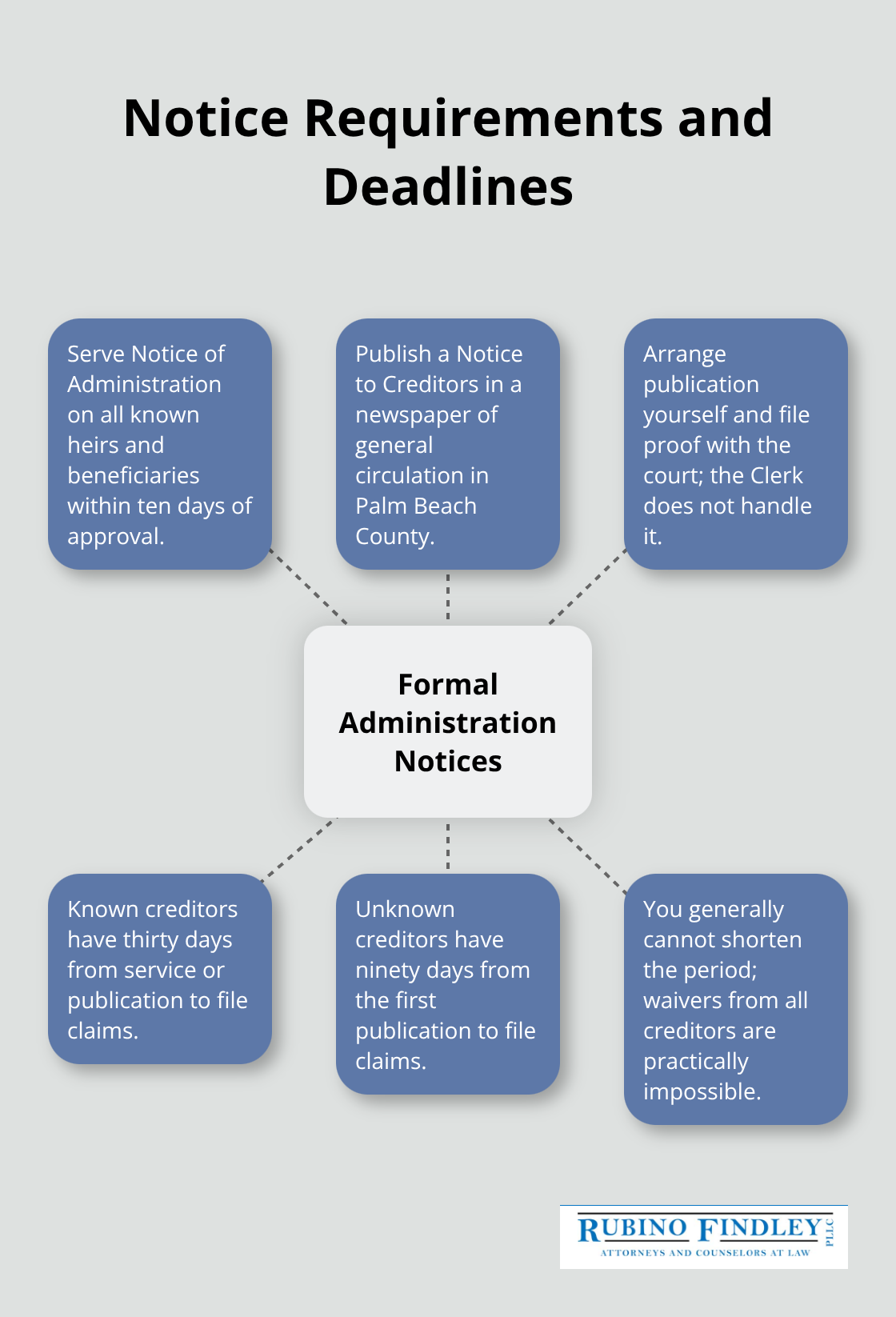
The notification phase starts immediately after court approval. In Summary Administration, the process moves faster because you’re not required to publish notices in newspapers or wait through a creditor claim period. In Formal Administration, you must serve Notice of Administration on all known heirs and beneficiaries within ten days, and you must publish a Notice to Creditors in a newspaper of general circulation in Palm Beach County. The Clerk does not handle this publication for you-you must arrange it yourself and file proof of publication with the court. Known creditors have thirty days to file claims, while unknown creditors have ninety days from the first publication. This creditor notification period cannot be shortened without written waivers from all creditors, which is practically impossible to obtain.
Timeline Expectations by Administration Type
Summary Administration typically closes within two to three months because there’s no creditor claim period. Formal Administration usually takes six to twelve months depending on estate complexity, the number of assets requiring appraisal, and whether disputes arise among heirs. Real estate sales within an estate often extend timelines by several additional months because the personal representative must obtain court approval before selling and then account for the sale proceeds.
Managing Assets and Closing the Estate
Throughout this entire process, the personal representative manages assets, pays valid debts and expenses, files tax returns when required, and maintains detailed records of every transaction. The court demands a final accounting before closing the estate, and this documentation must reflect every action the personal representative took on behalf of the estate.
Final Thoughts
Filing a petition for probate administration marks the beginning of a structured legal process that protects your family’s interests and honors the deceased’s wishes. The details matter tremendously-correct forms for your administration type, original documents submitted through proper channels, and clarity about which courthouse handles your case prevent costly delays that extend timelines by weeks. Summary Administration offers speed for smaller estates, while Formal Administration provides court oversight for complex situations with multiple assets or disputes among heirs.
The probate process involves multiple moving parts-court filings, creditor notifications, asset inventories, and final accountings-and each step carries specific deadlines and requirements that self-represented filers often miss. We at Rubino Findley, PLLC understand that families in Boca Raton and throughout Palm Beach County face enough stress without wrestling with legal complexity during an already difficult time. Professional legal guidance ensures your petition meets all statutory requirements, your documents reach the correct courthouse, and your case moves forward without preventable setbacks.
Your next step is straightforward: gather your documents, determine your administration type based on estate value and complexity, and contact Rubino Findley, PLLC for guidance. We offer a free consultation to review your situation and explain exactly what comes next for your estate.