




Probate Litigation Florida: Strategies For Resolving Complex Disputes
Probate disputes in Florida can tear families apart and drain resources quickly. When disagreements arise over wills, asset distribution, or executor decisions, the stakes feel impossibly high.
We at Rubino Findley, PLLC serve Palm Beach County, Florida, helping families navigate probate litigation with clear strategies and practical solutions. This guide walks you through the most common disputes and the paths forward.
Common Types of Probate Disputes in Florida
Will Contests and Validity Challenges
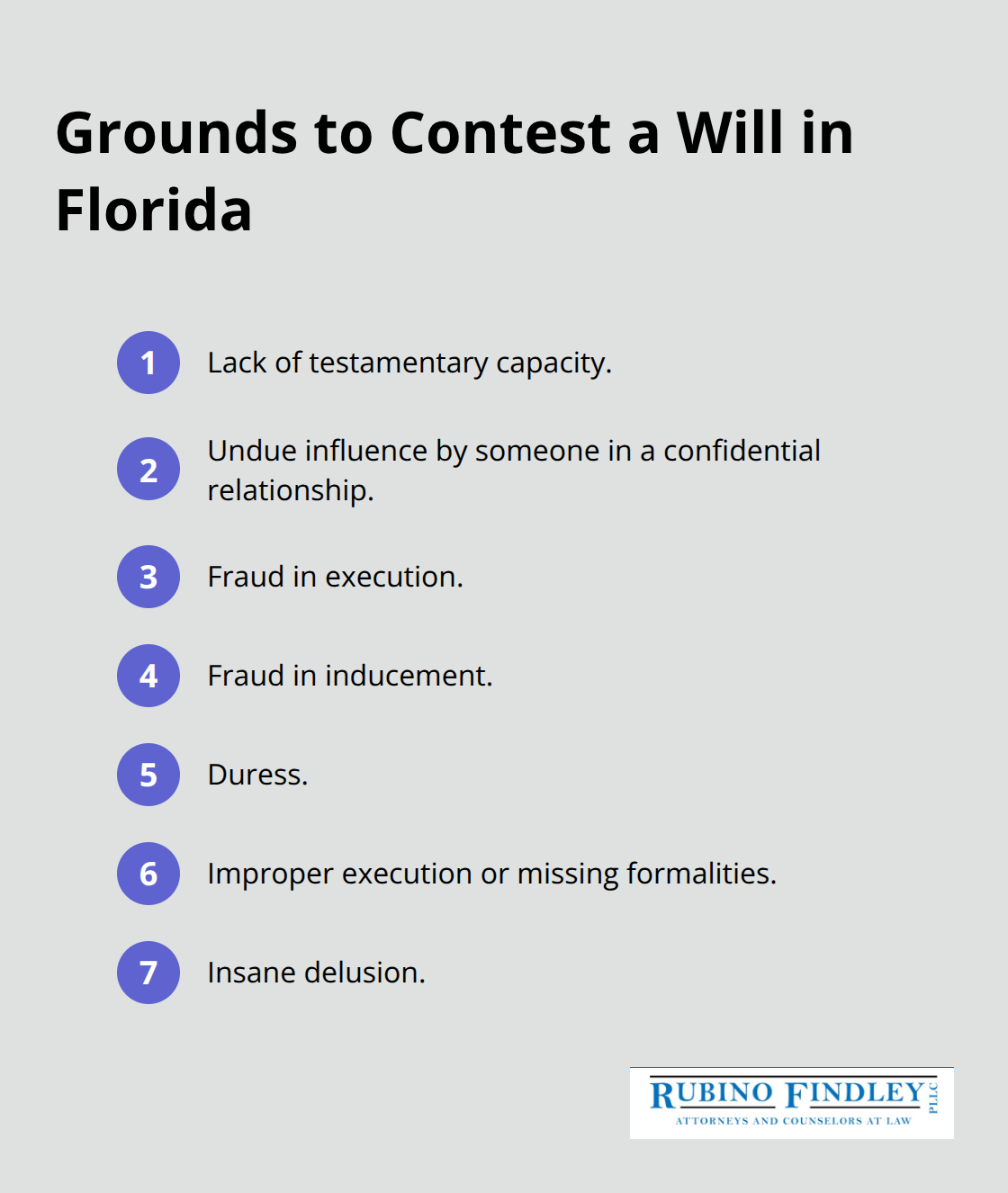
Will contests represent one of the most destructive probate disputes families face. These challenges attack the validity of the entire will or specific provisions within it. A will can be contested on grounds including lack of testamentary capacity, undue influence, fraud in execution, fraud in inducement, duress, improper execution, or insane delusion.
Testamentary capacity requires the testator to understand the nature and extent of their property, recognize the natural objects of bounty, and comprehend the practical effect of the will at the time of signing. The 90-day deadline to contest after Notice of Administration is strict-delays cost you the opportunity to challenge a will entirely. Undue influence claims demand proof that someone with a confidential relationship to the testator actively procured the will through pressure or manipulation.
Fraud in execution means the testator was deceived about what they actually signed, while fraud in inducement involves false statements that motivated the testator to make specific provisions. Technical execution failures (such as missing witness signatures or improper acknowledgment) are actually easier to prove than capacity or influence claims, making procedural defects a practical avenue when other grounds are weaker. The challenge process starts when you file a petition in probate court, which notifies the estate and triggers discovery where you gather medical records, communications, and expert testimony to support your position.
Disputes Over Asset Distribution and Inheritance
Disputes over asset distribution emerge when beneficiaries believe the executor or personal representative has distributed property unfairly or without proper accounting. Florida law requires personal representatives to serve Notice of Administration, maintain an inventory, and provide regular accountings to beneficiaries before final distribution. When a representative fails to account or distributes assets prematurely, beneficiaries can compel a full accounting and challenge improper transfers.
Breach of fiduciary duty claims allege the representative violated their duty of loyalty, failed to account properly, or mismanaged assets, with remedies including asset recovery or removal of the fiduciary. Re-titling or wrongfully transferring assets can deplete the estate rapidly, and probate courts apply equitable principles to correct ownership and order return of improperly transferred property. Complex family dynamics intensify these conflicts-multiple marriages, estranged relatives, or one child favored over another commonly trigger disputes that resurface during administration.
Disagreements Between Executors and Beneficiaries
Disagreements between executors and beneficiaries often center on whether the representative manages assets responsibly, pays creditors appropriately, or favors certain heirs. These tensions can escalate quickly when beneficiaries lack transparency about how the representative handles estate funds or when the representative makes decisions without consulting interested parties. Many of these disputes settle through mediation or negotiation rather than trial, which saves months and significant legal costs for all parties involved.
When conflicts arise, the path you take-whether negotiation, mediation, or litigation-depends on the specific facts and the relationship between the parties. Understanding your options and the strengths of your position requires careful analysis of the evidence and Florida probate law. The strategies available to resolve these disputes vary significantly based on the type of conflict and the parties involved.
How to Resolve Probate Disputes Without Destroying Your Finances
Most probate disputes settle before trial, and the ones that do typically cost families far less money when they pursue settlement or mediation early. The difference between resolving a conflict in three months versus three years can mean $50,000 to $200,000 in attorney fees alone, not counting the emotional toll on family relationships. Families often make critical mistakes by refusing to negotiate when settlement was possible, and they also waste resources on litigation when mediation would have resolved the matter faster. The path you choose depends on several factors: the strength of your legal position, the relationship you want to preserve with other parties, your timeline, and your budget.
Settlement Through Direct Negotiation
Negotiation and settlement discussions work best when both sides understand the real cost of continued conflict. Direct communication between parties or their attorneys can resolve distribution disputes, executor disagreements, and even some will contests when the underlying issues are financial rather than matters of principle. If your dispute centers on whether an executor properly accounted for estate funds or distributed assets fairly, you can often resolve this by requesting a detailed accounting and negotiating a settlement for any shortfalls. Many beneficiaries discover that once they see the actual numbers and the executor explains their decisions, tensions ease significantly. Try setting a clear deadline for settlement discussions and be realistic about what you can prove in court. If your case depends on proving undue influence or lack of testamentary capacity, you need medical records, witness testimony, and forensic evidence before you can credibly demand a settlement. Weak evidence means weaker settlement leverage.
Mediation as a Faster Alternative
Mediation offers a structured alternative where a neutral third party helps both sides reach agreement without a judge deciding the outcome. Most probate disputes in Florida courts are referred to mediation before trial, and many resolve during mediation sessions. The process typically takes one to three sessions over several weeks, costs between $1,500 and $5,000 in mediator fees split between parties, and keeps the details of your dispute confidential. Unlike litigation, mediation discussions cannot be used as evidence if settlement fails, which gives both sides freedom to explore creative solutions. A mediator helps you understand the other side’s position, identify common ground, and develop settlement terms that work for everyone.
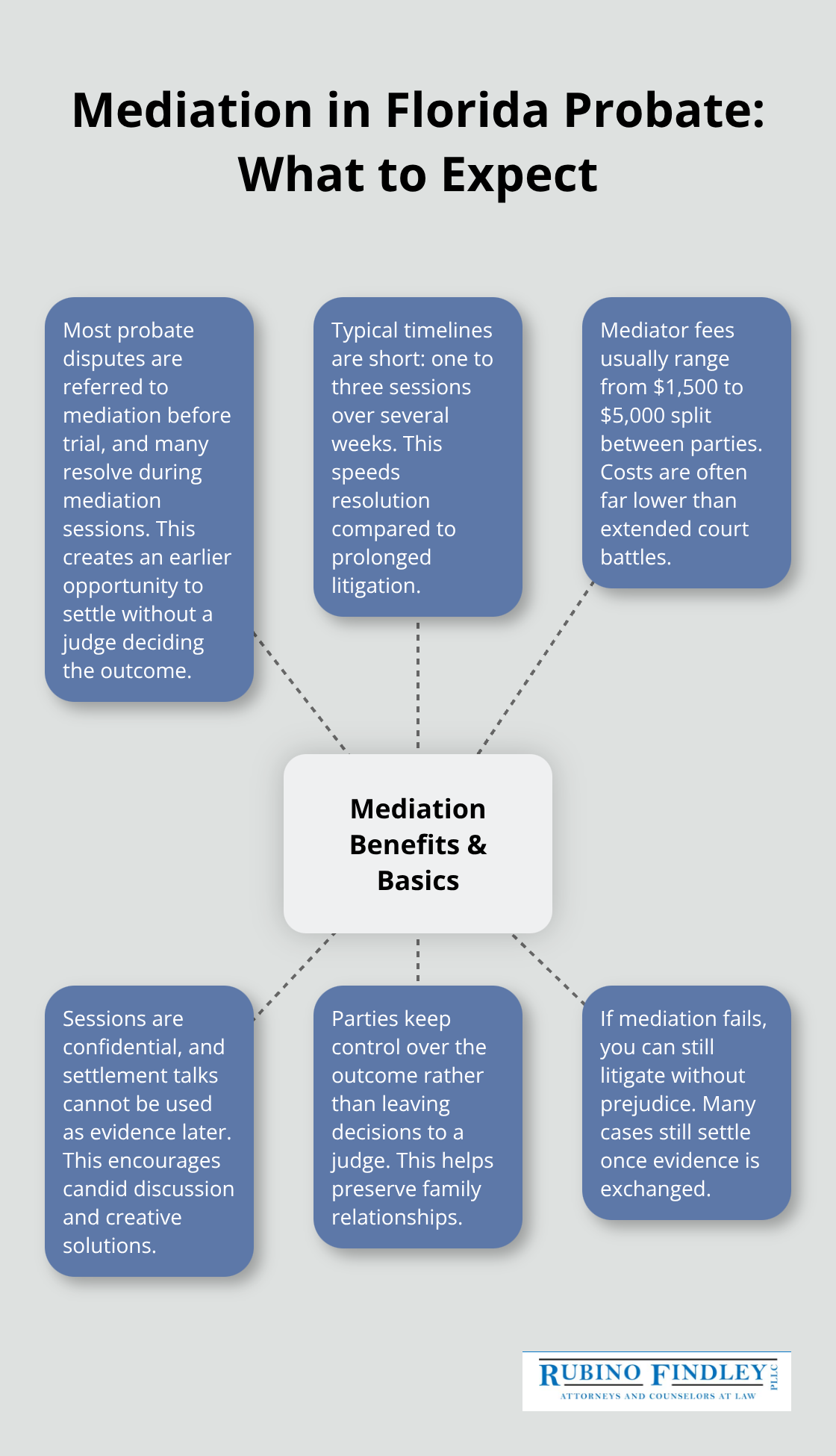
This approach preserves family relationships far better than courtroom battles and allows you to maintain control over the outcome rather than leaving decisions to a judge. If mediation fails, you can still pursue litigation with no prejudice, but most mediations in probate matters succeed because families recognize the cost of continued conflict.
When Litigation Becomes Necessary
Litigation becomes necessary when settlement and mediation fail or when one party refuses to negotiate in good faith. Florida probate disputes follow a structured court process that begins with filing a petition, serving the other parties, and exchanging documents through discovery. You gather medical records, communications, financial statements, and expert reports to support your claims. Depositions allow you to question the other side under oath and lock in their testimony before trial. Most cases settle during discovery when both sides see the strength of the evidence.
If your case goes to trial, a judge hears arguments and makes a binding decision on contested issues like will validity, fiduciary misconduct, or proper asset distribution. Trials in probate matters typically last one to three days and can occur six to twelve months after you file your petition, depending on court schedules. Court remedies are broad: a judge can invalidate an entire will, remove an executor, order return of misappropriated assets, or award damages for breach of fiduciary duty. The downside is that litigation costs $15,000 to $50,000 or more in attorney fees for a straightforward case, and complex disputes with expert testimony can exceed $100,000 before trial concludes.
Understanding Your Options in Palm Beach County
The choice between negotiation, mediation, and litigation shapes not only your financial outcome but also your family’s future. Each path carries different costs, timelines, and risks that you must weigh carefully against your specific circumstances. Your next step involves assessing which strategy fits your situation and understanding how Florida probate law applies to your particular dispute.
Why You Need an Attorney for Probate Disputes in Boca Raton
Florida Probate Law Contains Hidden Procedural Traps
Florida probate law contains traps that catch unrepresented parties constantly. The 90-day deadline to contest a will after Notice of Administration arrives is absolute-miss it and your challenge dies regardless of how strong your case is. The rules for filing proposed probate orders through the Online Scheduling System differ from standard e-filing, and submitting through the wrong portal gets your motion rejected without warning. Personal representatives must file death certificates and original wills with the Clerk’s Probate Division by hand delivery or mail to a specific P.O. Box, not through e-filing, and many people waste weeks discovering this procedural requirement the hard way.
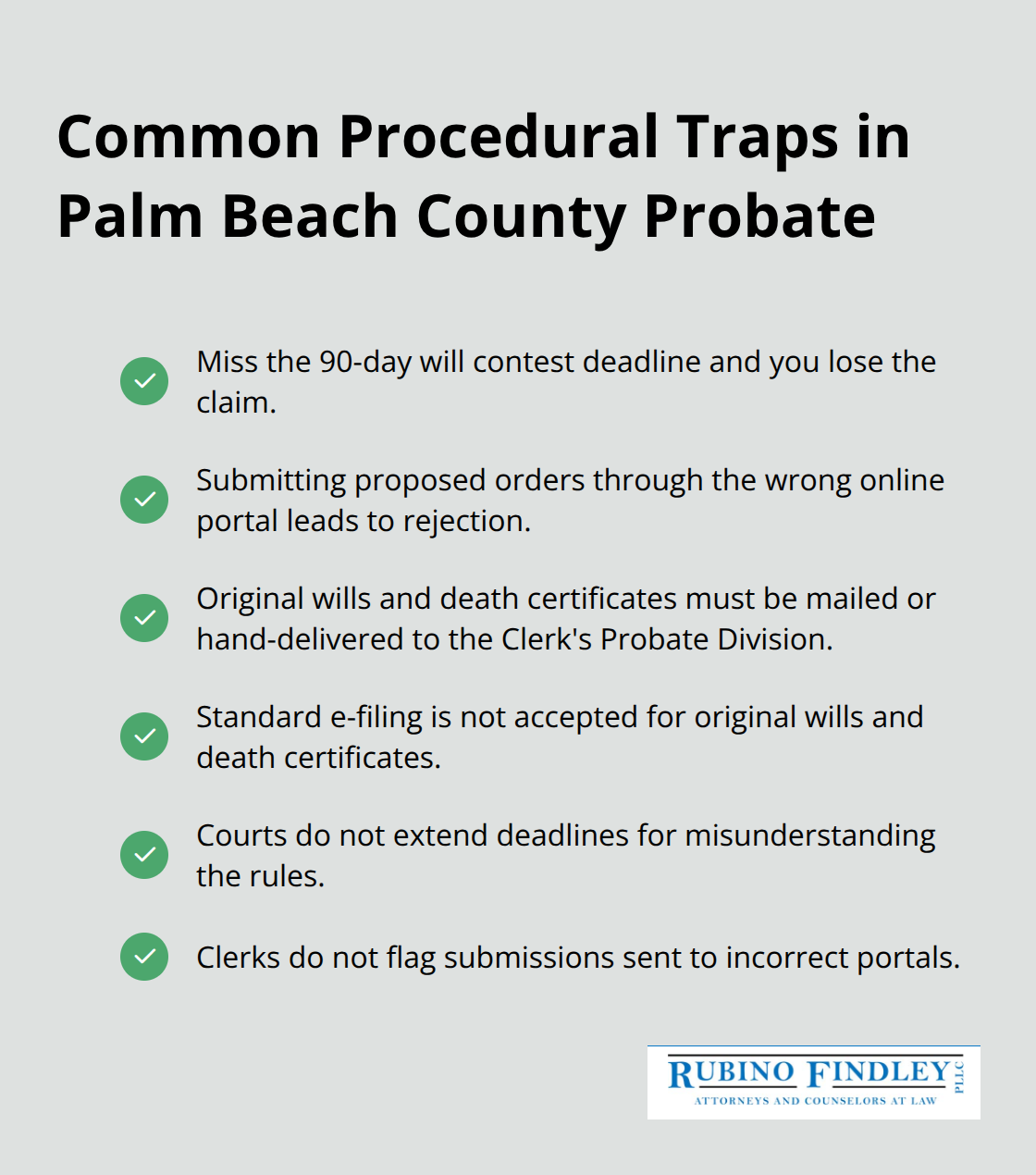
These procedural requirements operate independently of the strength of your legal position. A valid will contest fails if you miss the deadline, and a properly drafted motion disappears into the wrong filing system. Courts do not extend deadlines for parties who misunderstand the rules, and clerks do not flag submissions sent to incorrect portals. Attorneys who work in Palm Beach County probate courts know exactly which forms work, which deadlines matter, and which court divisions handle your specific dispute.
Evidence Gathering Requires Systematic Investigation
Probate disputes demand evidence that most people cannot gather alone. If you claim the testator lacked capacity, you need medical records from the relevant time period, testimony from witnesses who observed the testator’s mental state, and potentially a forensic psychiatrist to interpret that evidence credibly. Courts do not accept vague recollections or general concerns about someone’s competence-they require specific, documented facts.
Undue influence claims require showing that someone held a confidential relationship with the testator, actively procured the will, and benefited substantially from it. This demands discovery of communications, financial records, and witness interviews that an attorney knows how to conduct. Breach of fiduciary duty claims against executors require detailed accounting analysis to identify where assets went and whether the representative’s decisions violated their legal duties. These investigations take months and cost thousands, but they produce the evidence that either wins your case or forces the other side to settle. Attempting this alone typically results in weak claims that opposing counsel dismisses or that judges reject at trial.
Settlement Leverage Comes From Understanding Probable Outcomes
Settlement leverage depends entirely on how well both sides understand what a judge would actually decide if your case went to trial. Many beneficiaries overestimate their chances because they feel strongly about fairness, while many executors underestimate the risks they face from fiduciary duty claims. An attorney who has tried probate cases knows what judges accept as proof of undue influence, how courts value expert testimony on capacity, and what damages courts typically award for breach of fiduciary duty.
This knowledge transforms settlement negotiations from emotional arguments into realistic discussions about probable outcomes. Executors facing a breach of fiduciary duty claim often settle quickly once they understand that courts can order them to repay misappropriated funds plus attorney fees, while beneficiaries sometimes realize their will contest fails because they cannot meet Florida’s strict standards for proving lack of capacity. These insights come from experience handling similar disputes and understanding how Palm Beach County judges rule on probate matters. Without this perspective, both sides either reject reasonable settlements or accept terrible deals because they lack information about what a court would actually do with their case.
Local Court Knowledge Shapes Strategy
Each probate division in Palm Beach County operates with its own practices, judge preferences, and procedural expectations. Some judges move cases quickly through discovery while others allow extended timelines for expert reports. Some divisions favor mediation referrals early in litigation while others push cases toward trial. Knowing these local practices allows an attorney to time motions strategically, anticipate how judges will rule on evidence disputes, and position your case for the best possible outcome.
The difference between hiring an attorney and trying to handle probate litigation yourself often comes down to whether you have credible evidence or just suspicions, and credible evidence comes from systematic investigation that follows Florida law. Local knowledge accelerates this process and prevents the costly mistakes that unrepresented parties make when they misunderstand court procedures or misjudge what evidence actually proves.
Final Thoughts
Probate litigation in Florida demands more than good intentions or strong feelings about fairness. The disputes that tear families apart involve procedural deadlines you cannot miss, evidence you must gather systematically, and local court practices that determine whether your case succeeds or fails. The 90-day window to contest a will, the requirement to file documents through specific portals, and the burden of proving undue influence or lack of capacity all operate independently of what you believe is right.
Settlement negotiations work when both sides recognize the real cost of continued conflict and the probable result if a judge decides your case. Mediation resolves most probate disputes faster and cheaper than litigation because it allows creative solutions that courts cannot order. Litigation becomes necessary only when settlement fails or when one party refuses to negotiate in good faith, and even then, most cases settle during discovery once both sides see the strength of the evidence.
We at Rubino Findley, PLLC serve Palm Beach County and help families navigate probate litigation in Florida with clear strategies and practical solutions. Contact Rubino Findley, PLLC for a free consultation to assess your situation, understand your options, and move forward with confidence.