



Summary Administration Florida: A Faster Probate Alternative
Probate in Florida doesn’t always require a lengthy court process. If your estate qualifies, summary administration Florida offers a streamlined path that saves time and money.
We at Rubino Findley, PLLC help Palm Beach County families navigate this faster alternative. This guide walks you through what summary administration is, who qualifies, and how to avoid costly mistakes along the way.
What Summary Administration Actually Is
The Legal Definition and Framework
Summary administration is a Florida probate process for smaller estates that bypasses most court procedures. Under Florida Statutes Section 735.201, an estate qualifies if the total value of property subject to administration doesn’t exceed $75,000, or if the estate consists only of a homestead, exempt property, and allowances for the surviving spouse and minor children. The legal framework treats summary administration as a petition-based process rather than a full probate case, meaning the court doesn’t appoint a personal representative in the traditional sense. Instead, the petition goes directly to the judge, who reviews it and issues an order of summary administration if everything checks out.
How Summary Administration Works
This streamlined approach eliminates the need for creditor notices, bond requirements, and most of the paperwork that makes regular probate so time-consuming. Florida courts process summary administration petitions significantly faster than full probate cases, often within weeks rather than months or years. You file the petition with supporting documents, the court reviews the materials, and if the estate qualifies and all requirements are met, the judge signs an order.
Key Differences from Traditional Probate
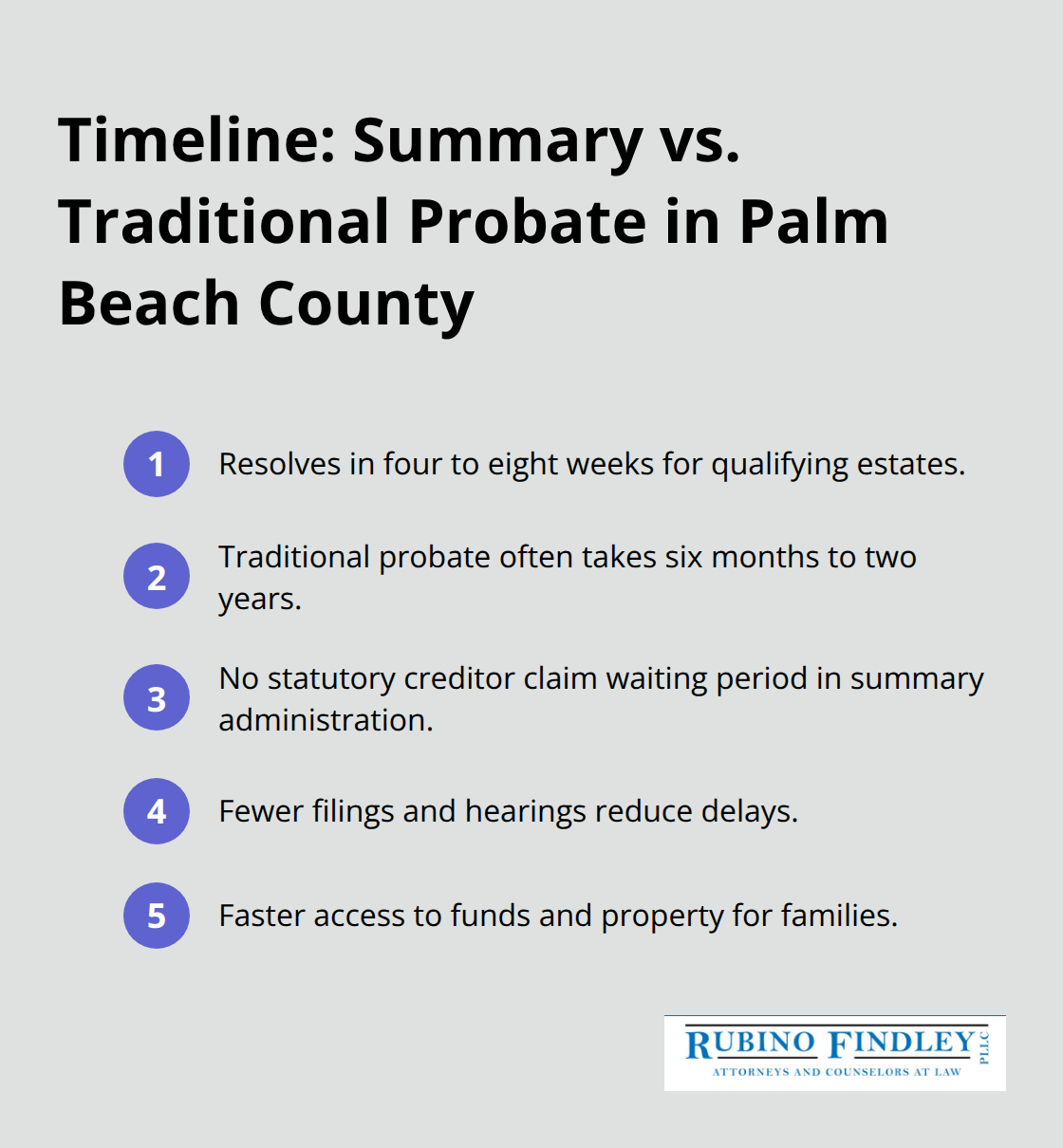
Traditional probate in Florida requires formal administration with a personal representative, court-supervised inventory filings, accounting statements, and a minimum waiting period. A traditional probate case in Palm Beach County typically takes six months to two years, depending on estate complexity and whether disputes arise. Summary administration skips these steps entirely-you don’t file inventories, you don’t publish notices to creditors in newspapers, and you don’t wait through the statutory creditor claim periods.
The contrast matters significantly. Traditional probate involves lower court involvement, fewer documents to prepare, and substantially reduced legal costs compared to full probate. However, summary administration only works if your estate truly qualifies under the $75,000 threshold and meets all other eligibility requirements. Getting this determination right from the start separates a smooth process from costly complications down the road.
Why Summary Administration Saves Time and Money
Timeline Advantages Over Traditional Probate
Summary administration in Florida resolves within four to eight weeks, compared to the six months to two years required for traditional probate in Palm Beach County. This speed matters because families access funds, transfer property, and close the estate far faster. The court eliminates the lengthy waiting periods that traditional probate mandates, which means no statutory creditor claim periods consuming months of calendar time. Repeated court filings, status hearings, and administrative delays plague standard probate cases, but summary administration avoids them entirely. For families facing immediate expenses or needing to settle an estate quickly, this compressed timeline proves invaluable.
Cost Breakdown: What You Actually Pay
Legal fees for summary administration run significantly lower than traditional probate. A typical summary administration case costs between $1,500 and $3,500 in attorney fees, while traditional probate in Florida averages $3,000 to $7,500 or more depending on estate size and complexity. Summary administration eliminates most of the work-you don’t file inventories with the court, you don’t prepare detailed accounting statements, and you don’t attend multiple hearings. Court filing fees themselves remain minimal compared to traditional probate.
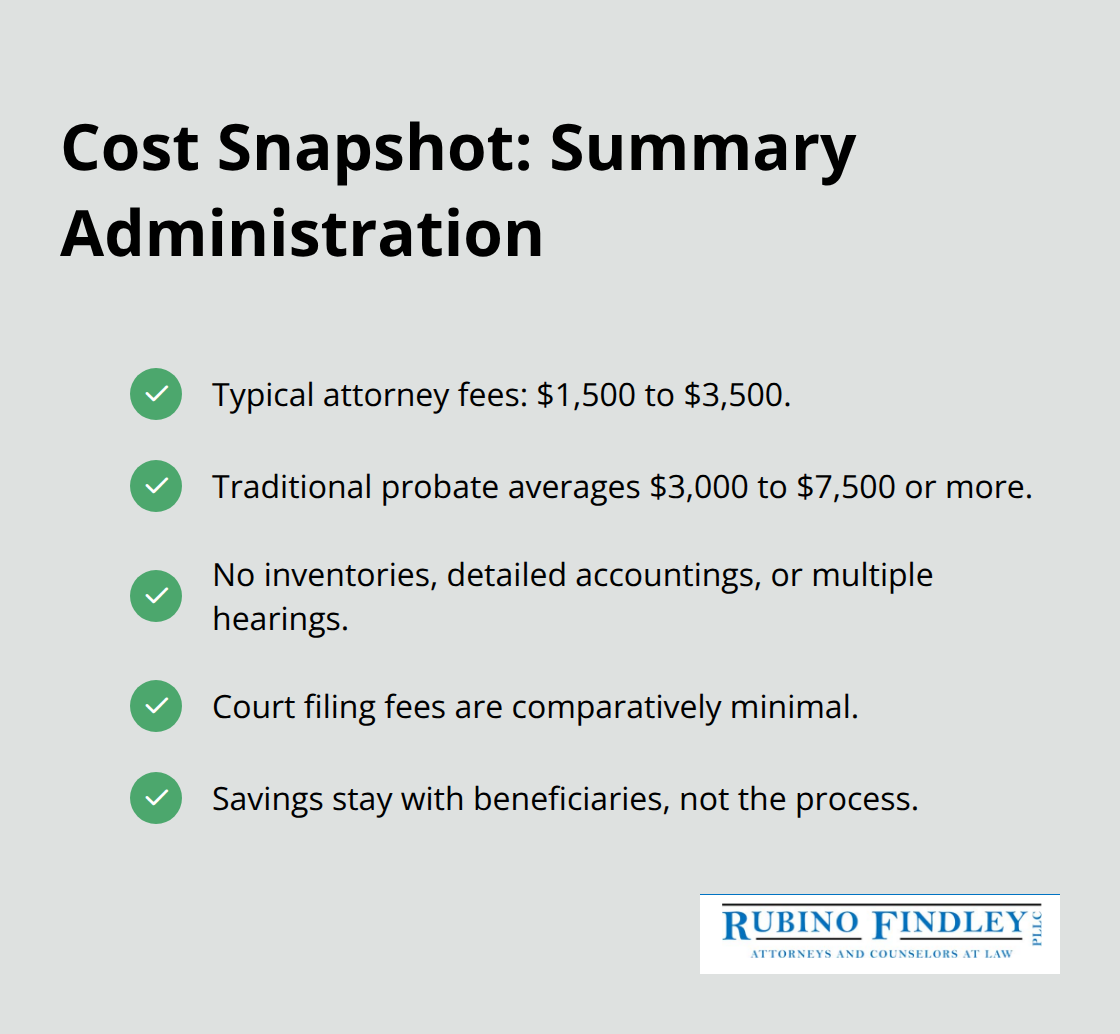
For an estate valued under $75,000, this cost reduction represents a substantial percentage savings that goes directly back to beneficiaries rather than toward legal proceedings.
Paperwork That Stays Simple
Summary administration requires far fewer documents than traditional probate. You file a petition, provide proof of death, include a list of heirs, show that the estate qualifies under the $75,000 threshold, and submit any creditor information. Traditional probate demands an inventory, an appraisal of assets, a detailed description of all property, creditor notices published in newspapers, accounting statements showing every transaction, and petitions for various court approvals. Summary administration cuts through this paperwork maze entirely. The simplified filing process means less room for errors, faster court processing, and reduced back-and-forth communication with the court about missing documents or corrections.
These cost and time savings make summary administration attractive, but only if your estate actually qualifies. Understanding the specific eligibility requirements separates estates that benefit from this streamlined process from those that don’t.
Common Mistakes to Avoid in Summary Administration
Miscalculating the $75,000 Threshold
The biggest mistake Palm Beach County families make involves misunderstanding what counts toward the $75,000 threshold. Many people include assets that Florida law specifically excludes from this calculation, inflating their estate value and discovering too late that they don’t qualify for summary administration. Florida law excludes homestead real estate, exempt property, and allowances for the surviving spouse and minor children from the threshold calculation. If your estate includes a home valued at $200,000 plus $50,000 in bank accounts, the home doesn’t count toward the $75,000 limit-only the liquid assets do. Filing for summary administration when your estate actually requires full probate forces you to restart the entire process and doubles your legal costs and timeline.
The court will reject an ineligible petition outright. This rejection adds weeks to the process while you gather additional documentation and refile. Beneficiaries wait longer for access to funds, and what should have been a four-week resolution stretches into months of unnecessary delay.
Submitting Incomplete or Incorrect Paperwork
Paperwork errors kill summary administration cases faster than any other problem. Missing a death certificate, listing heirs incorrectly, failing to identify all creditors, or submitting an incomplete petition forces the court to reject your filing and demand corrections. Each rejection adds weeks to the process, erasing the time savings that make summary administration attractive.
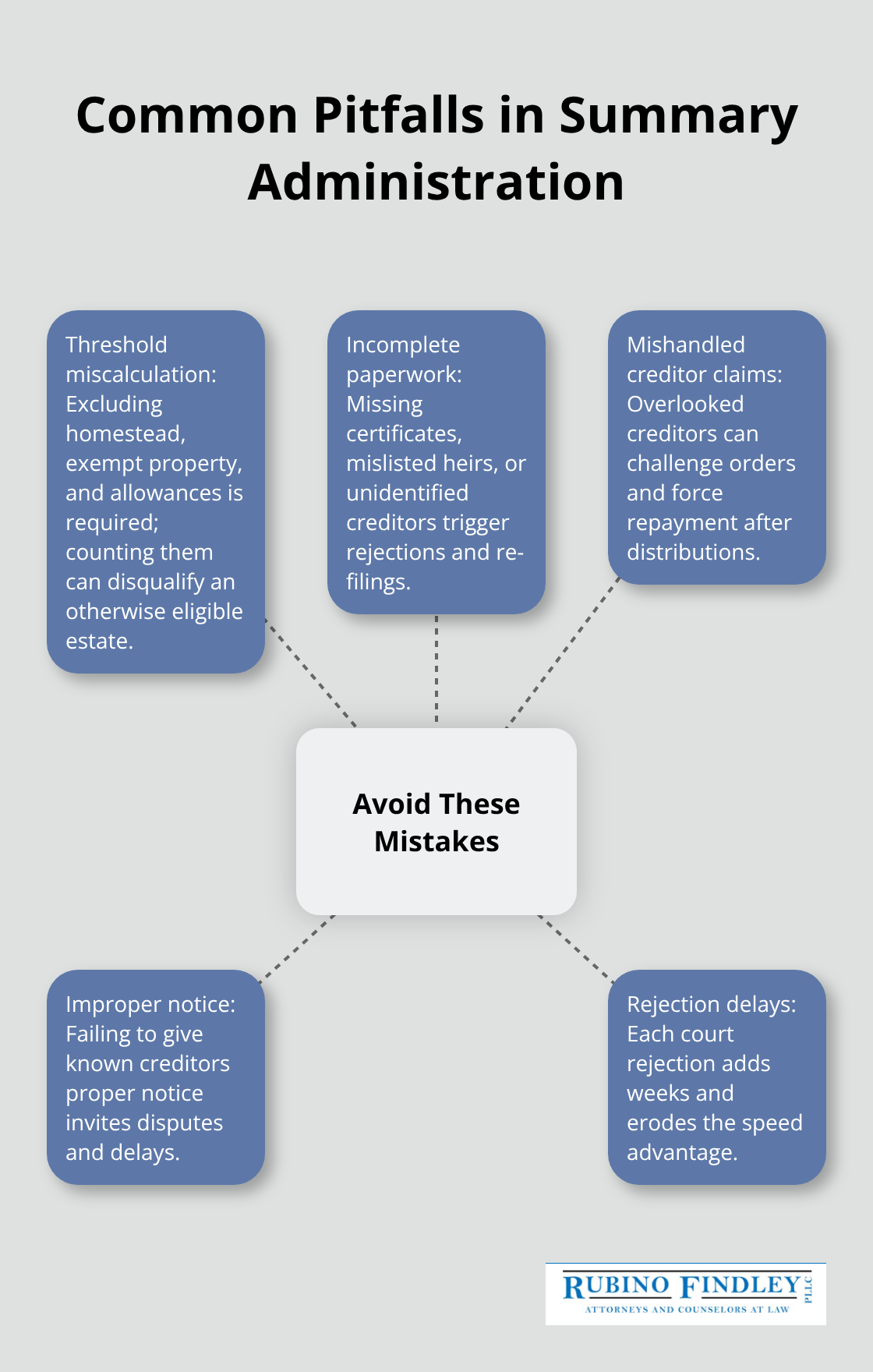
Creditor claims present another critical pitfall-if you overlook a creditor or mishandle their claim, they can challenge the final order and reopen the case months after you thought it was closed. Palm Beach County courts see this repeatedly: families file incomplete paperwork, receive rejection notices, file again with corrections, and then discover a creditor they missed, forcing additional filings and court involvement.
Handling Creditor Claims Improperly
Creditors have specific rights under Florida law, and summary administration doesn’t eliminate those rights-it simply streamlines the process. You must identify all known creditors and provide them with proper notice of the summary administration petition. Failing to notify a creditor doesn’t make their claim disappear; it simply delays the problem until after the court approves the order.
Once the court issues an order of summary administration, creditors still have a limited time to file claims against the estate. If you overlook a creditor during the initial filing, that creditor can emerge later and demand payment from the estate or from beneficiaries who already received distributions. This scenario transforms a closed case into an open liability that requires additional court filings and potentially forces beneficiaries to return funds they received in good faith.
The solution requires attention to detail and knowledge of what Palm Beach County courts specifically require. Small errors in documentation transform a four-week process into a four-month ordeal.
Final Thoughts
Summary administration Florida works best for estates under $75,000 that meet Florida’s specific requirements. If your estate qualifies, this streamlined process delivers real savings in both time and money compared to traditional probate. Most families in Palm Beach County who use summary administration resolve their cases within four to eight weeks rather than waiting months or years through standard probate procedures.
The mistakes we discussed earlier-miscalculating the threshold, submitting incomplete paperwork, and mishandling creditor claims-are entirely preventable with proper guidance. Getting these details right from the start determines whether your case closes smoothly or gets derailed by rejections and corrections. For Palm Beach County residents ready to explore whether summary administration fits your situation, contact Rubino Findley, PLLC to discuss your specific circumstances and guide you through the entire filing process.