



Palm Beach Probate Administration: Navigating Local Requirements
Probate administration in Palm Beach County involves specific rules and deadlines that differ from other Florida counties. The process can feel overwhelming when you’re managing an estate while grieving a loved one.
At Rubino Findley, PLLC, we help families in Boca Raton and throughout Palm Beach County handle probate efficiently and correctly. This guide walks you through the local requirements and common obstacles you’ll face.
What Makes Palm Beach Probate Different from Other Florida Counties
Filing Requirements Unique to Palm Beach County
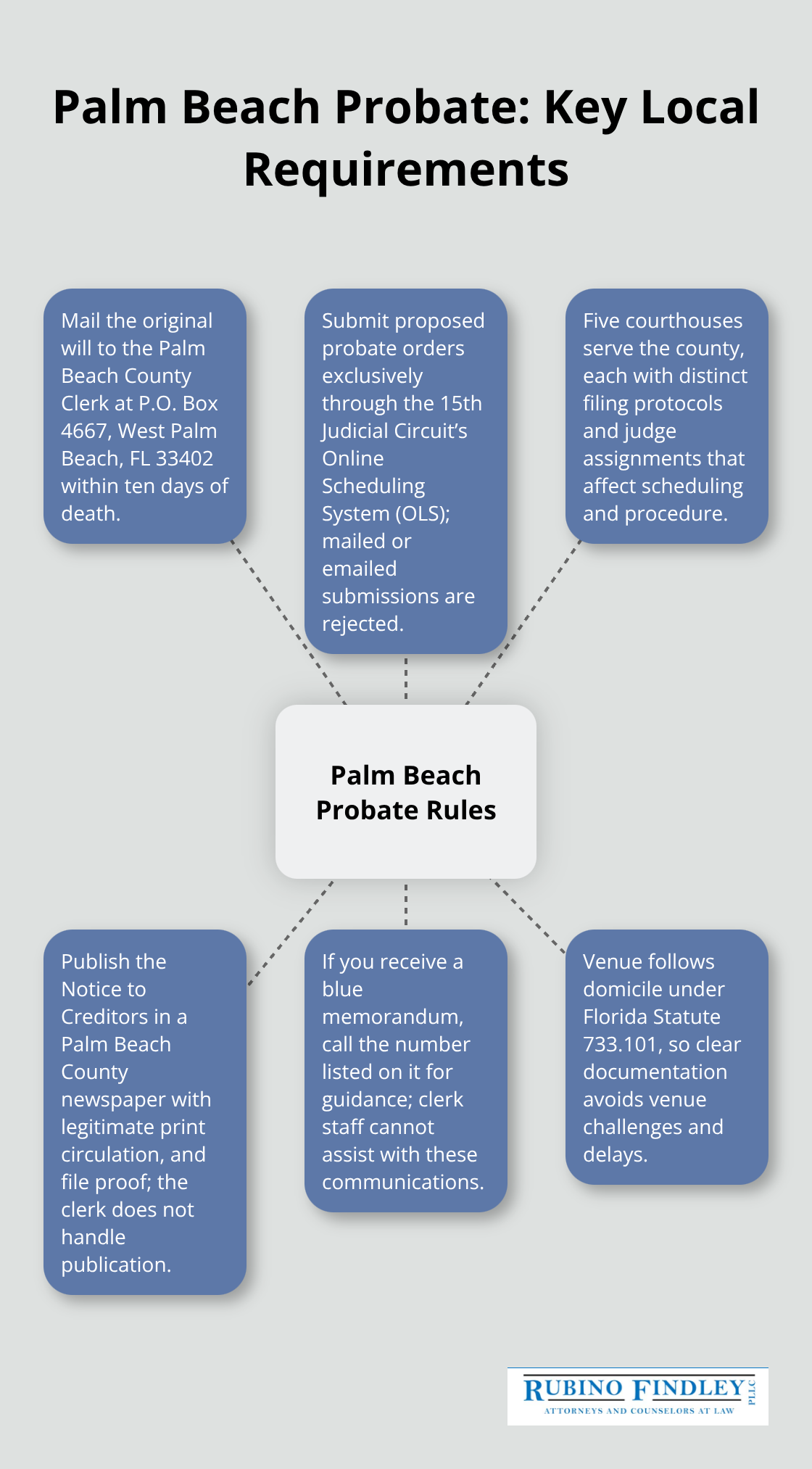
Palm Beach County probate operates under Florida Statutes Chapters 731–735, but the local court procedures and filing requirements create a distinctly different experience than probate in Miami-Dade or Broward County. The 15th Judicial Circuit serves Palm Beach County across five courthouses-West Palm Beach, Delray Beach, Palm Beach Gardens, Belle Glade, and Boca Raton-and each location maintains its own filing protocols and judge assignments. Original wills must go directly to the clerk’s office at P.O. Box 4667, West Palm Beach, FL 33402, while proposed probate orders require submission exclusively through the 15th Judicial Circuit’s Online Scheduling System (OLS). This dual-filing approach catches many families attempting to handle probate without guidance.
Determining Venue in Palm Beach County
Venue in Palm Beach County follows Florida Statute 733.101, which directs cases to file in the county where the decedent held domicile at death. Domicile extends beyond the last known address-voter registration, driver’s license location, mail delivery address, and personal property location all factor into the determination. For Boca Raton residents, this typically means filing at the main courthouse or the South County location in Delray Beach, depending on specific circumstances. Establishing clear domicile documentation prevents venue challenges that delay administration.
Timeline and Cost Differences
Filing deadlines in Palm Beach County align with state law but demand strict adherence to local timelines. Original wills reach the clerk within ten days of death at no filing fee for deposit, though formal administration opens court fees that vary by estate size. Summary administration-available when the estate’s probate value doesn’t exceed $75,000 (or when the decedent died more than two years ago with no asset cap)-costs considerably less and moves faster, typically resolving in two to three months rather than the six to twelve months formal administration requires. The creditor notice period remains ninety days in formal cases, with known creditors receiving thirty days to file claims after publication in a Palm Beach County newspaper with legitimate print circulation. You must arrange and pay for this publication yourself; the clerk does not handle it.
Court Procedures and Judge Assignment
Court procedures in Palm Beach require that blue memoranda from probate case managers receive attention by calling the telephone number listed on the memorandum-clerk staff cannot assist with these communications. Judge assignment depends on the case division code (such as IB), and the 15th Judicial Circuit website lists divisions and judges with specific hearing instructions. These local details separate successful probate administration from costly delays and procedural missteps. Understanding which courthouse handles your case and which judge oversees your matter shapes how quickly your estate moves through the system.
The specific requirements Palm Beach County imposes on personal representatives and families create obligations that differ significantly from other Florida jurisdictions, making local knowledge essential as you move forward with the administration process.
What Complications Arise When Palm Beach Estates Span Multiple Counties
Navigating Ancillary Probate Across Jurisdictions
Administering an estate that includes property in multiple Florida counties or out-of-state locations demands a fundamentally different approach than handling assets confined to Palm Beach County. Many families discover too late that they cannot file one probate case in Palm Beach and expect courts in other jurisdictions to recognize the authority granted by the 15th Judicial Circuit. Florida law requires ancillary probate administration in any county where the decedent owned real property, meaning you file a separate probate case in each location. For a Boca Raton resident who owned a vacation home in Broward County and commercial property in Duval County, this translates to three separate court filings, three separate personal representative appointments, three sets of creditor notices, and three final accountings. The Palm Beach County probate case becomes the domiciliary administration, while the others function as ancillary proceedings.
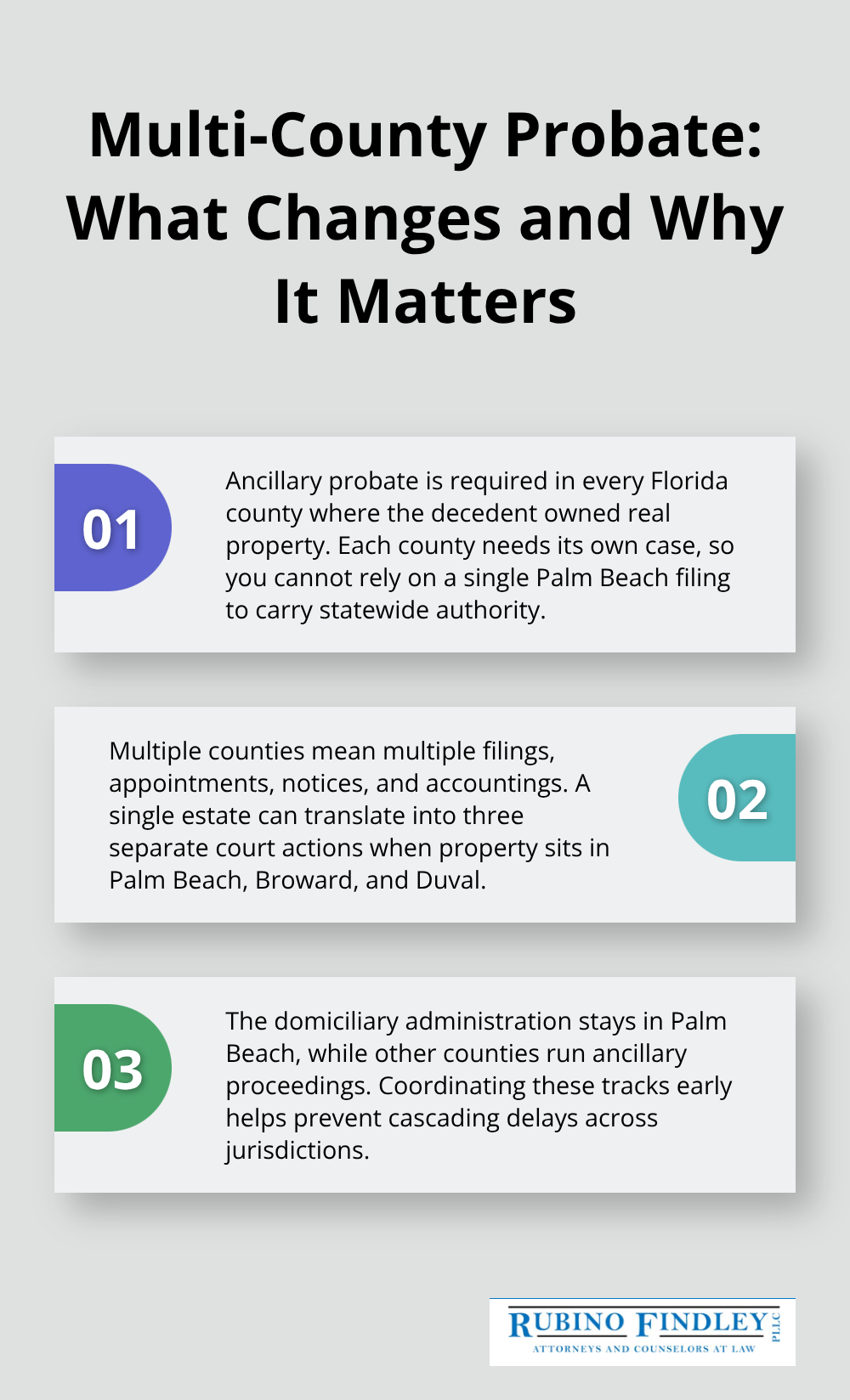
Each courthouse maintains its own filing procedures, judge assignments, and local rules. The 15th Judicial Circuit’s Online Scheduling System does not govern filings in other counties, forcing you to navigate Broward County’s separate procedures and Duval County’s distinct requirements. This complexity multiplies costs and extends timelines significantly.
Timeline Complications in Multi-County Administration
Timeline complications multiply rapidly when property spans jurisdictions. While your Palm Beach case may progress smoothly, delays in another county can halt final distribution of the entire estate. Creditor disputes and notice periods run independently in each jurisdiction, extending the overall administration timeline substantially. A straightforward estate that would close in eight months in Palm Beach alone might require fourteen months when multi-county property exists. Coordinating all filings simultaneously rather than sequentially prevents months of unnecessary delays and reduces the burden on the personal representative managing multiple court systems.
Beneficiary Disputes Across Jurisdictions
Disputes among beneficiaries and contested estate claims intensify dramatically in multi-county situations because disagreements in one jurisdiction can trigger objections in others. A beneficiary challenging the personal representative’s actions in Palm Beach County may file competing claims in Broward County, forcing the court system to reconcile conflicting positions across jurisdictions. Complex estates involving business interests, rental properties, or substantial investment portfolios create additional friction points. When an estate includes a family business operating in multiple counties, determining its value for distribution purposes becomes extraordinarily difficult. Appraisals vary, business valuations require specialized analysis, and beneficiaries frequently dispute whether the appraiser selected truly reflects fair market value. The Florida Probate Code does not mandate specific valuation methods, leaving room for legitimate disagreement about what constitutes accurate assessment.
Will Contests and Litigation Across State Lines
Contested wills present the most severe complications in multi-county estates. If one beneficiary believes the will was executed under undue influence or that the decedent lacked testamentary capacity, the resulting litigation can consume two to three years and costs exceeding the disputed assets themselves. Palm Beach County courts handle will contests under Florida Statute 733.109, requiring the challenging party to establish grounds that meet strict legal standards. Courts rarely overturn validly executed wills, but the litigation process itself paralyzes estate administration. During a contested will proceeding, the personal representative cannot distribute assets, creditors cannot be paid, and beneficiaries remain in limbo. Professional legal guidance is essential from the earliest stages of administration, particularly when property locations span multiple states or counties.
How to Organize Estate Documents and File Probate Correctly
Collect and Categorize Estate Assets
Estate administration starts the moment you collect the decedent’s documents, and this step determines whether your probate case moves smoothly or stalls for months. Locate the original will (if one exists), death certificate, bank statements, investment account records, property deeds, mortgage documents, tax returns from the past three years, and insurance policies. Florida Statute 733.604 requires the personal representative to file an inventory of estate assets within sixty days of receiving Letters of Administration, so incomplete documentation at this stage forces you to chase records later under time pressure.
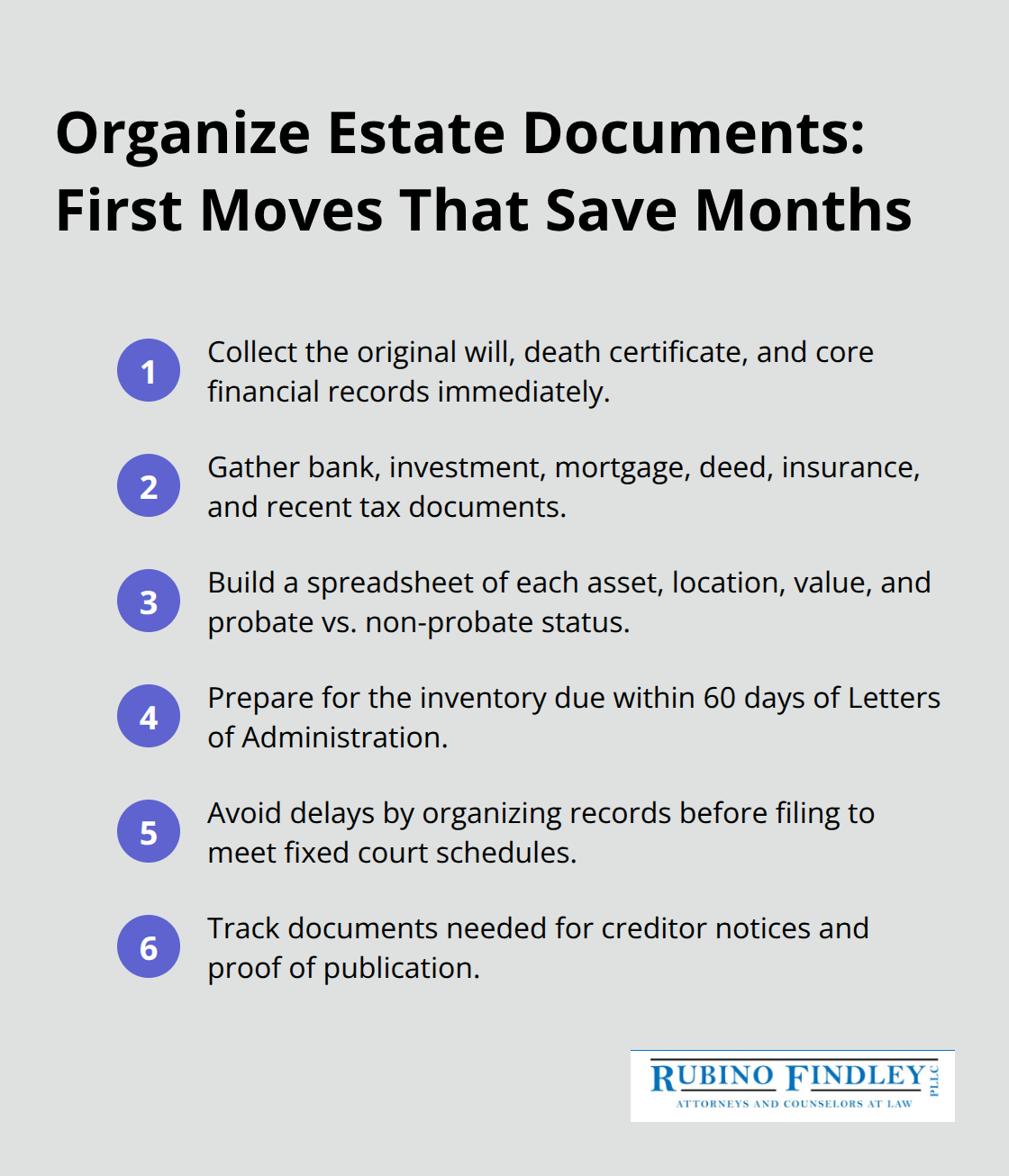
Organizing financial records and asset documentation before probate begins accelerates the entire process significantly, and many families waste weeks searching safe deposit boxes, contacting distant financial institutions, or locating property records that should have been organized immediately after death.
Create a spreadsheet listing each asset, its location, current value, and whether it passes through probate or transfers outside the probate process through survivorship titles or payable-on-death designations. This distinction matters enormously because only probate assets require court filing and creditor notices.
Submit the Original Will to the Palm Beach County Clerk
The Palm Beach County Clerk’s office does not accept email submissions for original wills-they must be mailed to P.O. Box 4667, West Palm Beach, FL 33402 within ten days of death with no filing fee for deposit. This initial step protects the will and creates an official record, but it represents only the first filing requirement you will encounter. Formal administration filings and proposed probate orders follow completely different procedures and must be submitted exclusively through the 15th Judicial Circuit’s Online Scheduling System; mailing them to the clerk or attempting email submission results in rejection and delays your case.
The Online Services registration takes approximately fifteen minutes, and the court provides a tutorial video on the CourtHelp4U YouTube channel. Once registered, you upload documents directly into the system rather than handling paper copies, which accelerates court review and reduces the likelihood of procedural defects.
Meet Critical Filing Deadlines
Filing deadlines in Palm Beach County demand precision because missing them creates permanent consequences. The original will reaches the clerk within ten days at no cost, but if you proceed to formal administration, you must file a petition within sixty days or risk complications with creditor claims and asset transfers. Publication of the Notice to Creditors in a Palm Beach County newspaper with legitimate print circulation cannot be handled by the clerk-you arrange and pay for publication directly, then file proof with the court.
Known creditors receive a separate thirty-day notice after publication, and the ninety-day creditor claim period runs from the publication date, not from the decedent’s death. Missing this timeline means creditors can file claims after the deadline expires, potentially reopening your case or forcing the personal representative to pay claims personally. Many families attempt probate administration without legal guidance and fail to understand that creditor notices require specific language, proper newspaper selection, and documented proof of publication. Courts reject improperly published notices, extending timelines by months.
Manage Inventory and Accounting Requirements
The personal representative’s inventory filing at sixty days, the final accounting due within twelve months of Letters issuance, and the discharge petition that closes the estate all operate on fixed schedules that the 15th Judicial Circuit enforces strictly. These deadlines do not shift or extend without court approval, and missing them complicates the entire administration process. Proper document organization at the outset prevents scrambling to locate records under deadline pressure. The difference between a well-organized estate file and a chaotic one often determines whether administration takes eight months or eighteen months.
Final Thoughts
Palm Beach probate administration demands attention to local court procedures, filing deadlines, and venue rules that differ significantly from other Florida counties. The five courthouses serving Palm Beach County, the mandatory use of the Online Scheduling System for proposed orders, and strict creditor notice requirements create a complex landscape that catches families unprepared. Missing a single deadline or filing in the wrong location extends your case by months and increases costs substantially.
The key to navigating this process successfully lies in organizing estate documents immediately after death, understanding which assets pass through probate versus those that transfer outside the court system, and recognizing when multi-county property demands ancillary administration in additional jurisdictions. Personal representatives who gather financial records, locate the original will, and identify all real property before filing avoid the scramble that typically occurs under deadline pressure. The difference between a well-organized estate file and a chaotic one often determines whether administration takes eight months or eighteen months.
Professional legal guidance from someone familiar with Palm Beach County’s specific requirements prevents costly mistakes that can reopen your case or force the personal representative to pay claims personally. At Rubino Findley, PLLC, we help families in Boca Raton and throughout Palm Beach County navigate probate efficiently and correctly. If you are managing an estate in Palm Beach County or want to establish an estate plan that prevents probate complications for your family, contact Rubino Findley, PLLC to schedule your free consultation.