




Intestate Succession Boca Raton: Who Inherits When There Is No Will
Intestate succession Boca Raton families face often comes as a surprise. When a loved one dies without a valid will, many people assume the closest family member simply takes over, or that everything automatically goes to the surviving spouse. Florida law follows a precise order instead, and that order can produce results the person who died never expected, particularly in blended families, second marriages, and families with relatives living out of state.
At Rubino Findley, PLLC, we help families throughout Boca Raton and Palm Beach County understand who inherits, who can serve as personal representative, and what steps come next when there is no will. This guide explains how Florida’s intestacy rules actually work, how the order of heirs plays out in real family situations, and the mistakes that cause delays and disputes, so you can move forward with confidence.
How Intestate Succession Actually Works in Florida
Intestate succession is the set of default rules that decides who receives a person’s property when that property is not effectively disposed of by a will. Under Section 732.101, Florida Statutes, any part of the estate of a decedent not effectively disposed of by will passes to the decedent’s heirs as prescribed in the Florida Probate Code. The same statute provides that the decedent’s death is the event that vests the heirs’ right to the intestate property. These rules apply whether the person never signed a will at all or left a will that fails to cover some of the property.
Who Counts as an Heir
Florida’s Probate Code defines heirs as those persons, including the surviving spouse, who are entitled under the statutes of intestate succession to the property of a decedent. The definition of descendant is equally important. Under Section 731.201, a descendant is a person in any generational level down the decedent’s descending line, including children, grandchildren, and more remote descendants. The intestacy statutes list spouses, descendants, parents, siblings, and more distant blood relatives, but they make no provision for unmarried partners or close friends. Stepchildren who were never adopted are not descendants, so they generally inherit only in the rare case where no blood relatives survive and Section 732.103 sends the estate to the family of the decedent’s last deceased spouse. In practice, people in these relationships should count on inheriting only if a will, trust, or other planning document provides for them.
The Surviving Spouse’s Share
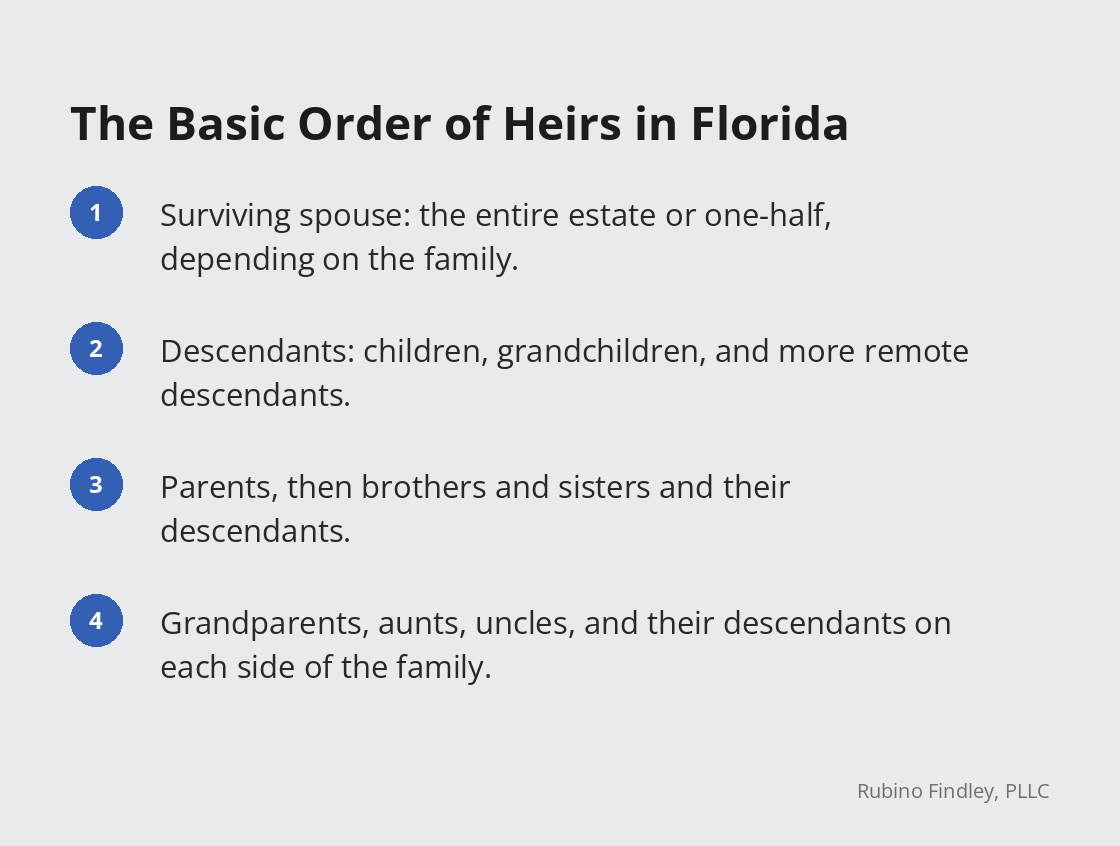
The spouse’s share depends on the family structure. Under Section 732.102, the surviving spouse receives the entire intestate estate if the decedent left no surviving descendants. The spouse also receives everything if all of the decedent’s descendants are also descendants of the surviving spouse and the surviving spouse has no other descendants. The spouse receives one-half of the intestate estate if the decedent has one or more surviving descendants who are not lineal descendants of the surviving spouse, or if all of the decedent’s descendants are also the spouse’s descendants but the spouse has one or more descendants who are not the decedent’s. In blended families, that one-half rule comes up far more often than people expect.
What Happens to the Rest of the Estate
Whatever does not pass to a surviving spouse, or the entire estate if there is no spouse, follows the order in Section 732.103. It goes first to the decedent’s descendants. If there are none, it goes to the decedent’s father and mother equally, or to the survivor of them. If there are no parents, it goes to the decedent’s brothers and sisters and the descendants of deceased brothers and sisters. Beyond that, the estate is divided between the paternal and maternal sides of the family, passing to grandparents and then to aunts, uncles, and their descendants. Under Section 732.104, descent is per stirpes, which means the share of a relative who died first generally passes down to that relative’s own descendants.
Applying the Rules to Real Florida Families
The statutory order looks straightforward on paper, but families rarely fit a simple diagram. Adoptions, children born after a parent’s death, half siblings, and estranged relatives all have specific treatment under Florida law. Understanding these situations early helps the personal representative identify every heir correctly before the estate moves forward.
Adopted Children and Children Born Outside Marriage
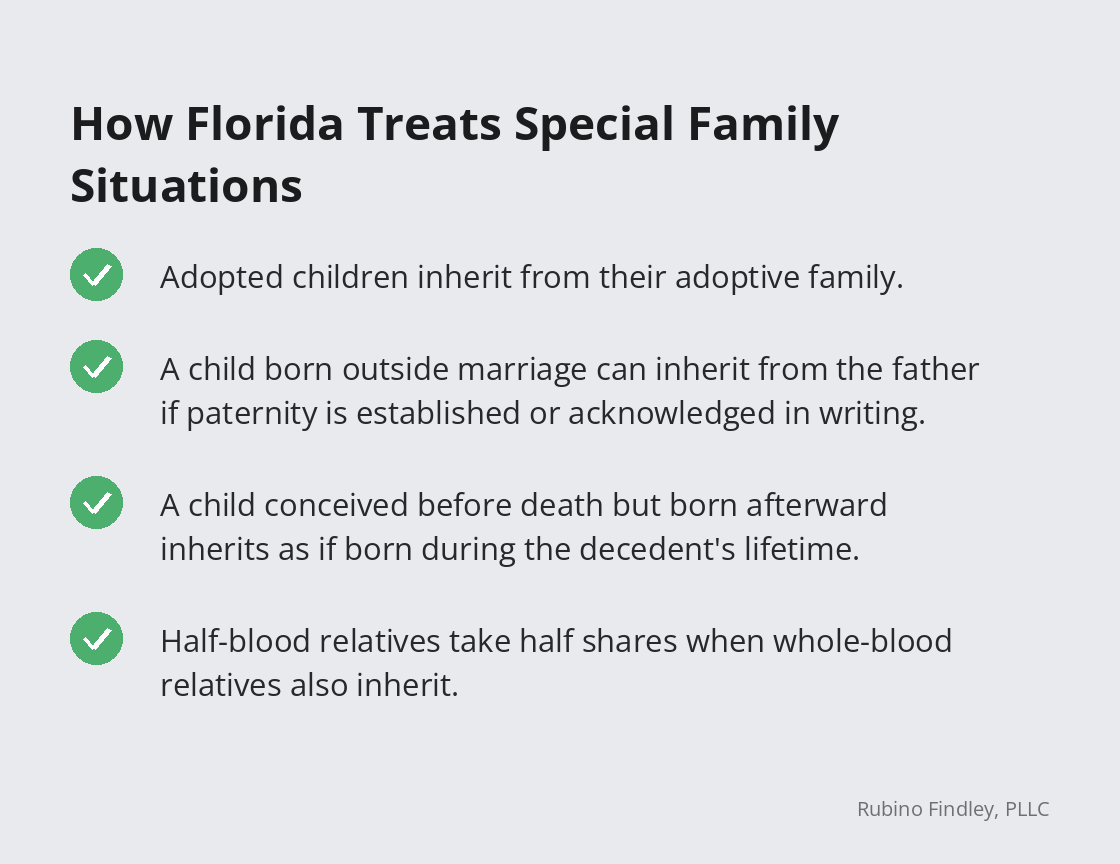
Section 732.108 treats an adopted person as a descendant of the adopting parent and as part of the adopting parent’s family for intestate succession, and generally not as a descendant of his or her natural parents, with exceptions such as adoption by the spouse of a natural parent. A person born out of wedlock is a descendant of his or her mother. That person is also a descendant of the father if the parents participated in a marriage ceremony, even a void one, if paternity is established by an adjudication before or after the father’s death, or if the father acknowledged paternity in writing. Under Section 732.106, heirs conceived before the decedent’s death but born afterward inherit as if they had been born during the decedent’s lifetime.
Half Siblings and Other Collateral Relatives
When an estate passes to brothers, sisters, or other collateral relatives, Florida distinguishes between whole blood and half blood. Under Section 732.105, when part of the collateral kindred are of the whole blood and part are of the half blood, those of the half blood inherit only half as much as those of the whole blood, but if all of them are of the half blood, they take whole parts. This rule matters most when a person dies without a spouse, children, or surviving parents, and the estate passes to a mix of full siblings and half siblings from a parent’s other relationship.
When a Relative Is Barred From Inheriting
Some relatives who would otherwise inherit are excluded by statute. Under Section 732.1081, a natural or adoptive parent whose parental rights were terminated under Chapter 39 before the child’s death is barred from inheriting from or through that child and is treated as if the parent had predeceased the child. Under Section 732.802, a person who unlawfully and intentionally kills or participates in procuring the death of the decedent is not entitled to benefits under the Florida Probate Code, and the estate passes as if that person had predeceased the decedent. If no person entitled to a share survives the decedent, Section 732.107 provides that the share escheats to the state.
What Delays an Intestate Estate in Palm Beach County
Most problems in intestate estates do not come from the inheritance rules themselves. They come from gaps in information, confusion about who has authority to act, and assumptions about property that never passes through probate in the first place. Planning around these issues can keep an estate from stalling for months.
Confusion Over Who Serves as Personal Representative
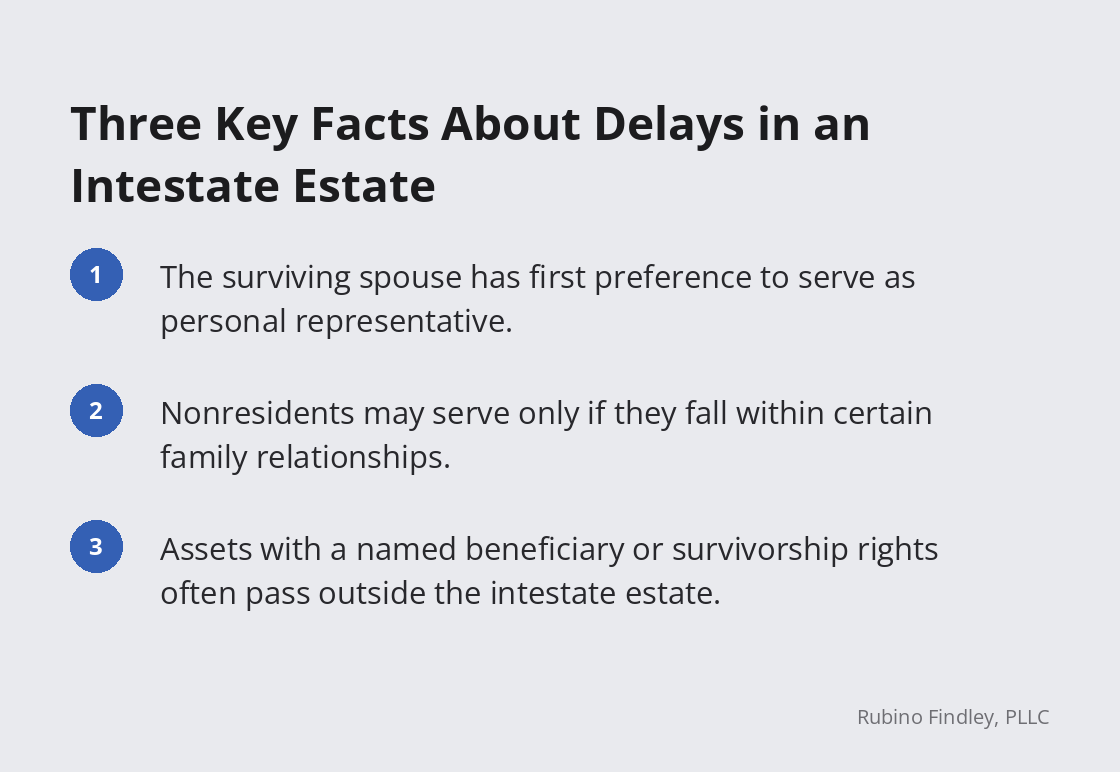
Someone has to be appointed by the court to administer the estate, and Florida sets an order of preference. Under Section 733.301, in intestate estates the court gives preference first to the surviving spouse, then to the person selected by a majority in interest of the heirs, and then to the heir nearest in degree, with the court selecting the best qualified if more than one applies. Family members who live outside Florida should also know that Section 733.304 limits who may serve as a nonresident personal representative to certain relatives, such as a legally adopted child or adoptive parent, a person related by lineal consanguinity, a spouse, a brother, sister, uncle, aunt, nephew, or niece, someone related by lineal consanguinity to any of those persons, or the spouse of a person who qualifies.
Overlooking Heirs or Misreading the Family Tree
Because the statutes reach so far down the family tree, it is easy to miss someone. A child from an earlier relationship, the descendants of a sibling who died years ago, or a half sibling the family lost touch with may all be entitled to a share. Building an accurate family tree, gathering birth, marriage, divorce, and death records, and confirming each relative’s status before distributing anything protects the personal representative and reduces the risk of disputes later. When the estate qualifies, a streamlined option such as summary administration in Florida may be available, but it still depends on identifying the correct heirs.
Assuming Every Asset Passes Through Intestacy
Intestacy rules govern only the property that is not effectively disposed of by a will, and many assets are structured to pass on their own terms. Accounts with a named beneficiary, property held jointly with survivorship rights, and assets held in a trust often move outside the intestate estate entirely. Families sometimes argue over property that the intestacy rules do not even control, while overlooking assets that do belong to the estate. A careful inventory that separates probate assets from assets that pass by other means is one of the most useful early steps a family can take.
Final Thoughts
Florida’s intestacy rules give every estate a clear default path, but that path does not always match what a family expects. The surviving spouse may receive the whole estate or only half, distant relatives may share in the estate when closer family is gone, and partners, friends, and stepchildren are usually left out unless a planning document provides for them.
If you are handling the estate of a loved one who died without a will, focus first on identifying every heir, confirming who may serve as personal representative, and separating probate assets from those that pass by other means. If you have not yet signed a will, these rules are a strong reminder that a thoughtful estate plan lets you decide who inherits instead of leaving that choice to the statute.
If you’re dealing with an estate that has no will or want to put your own plan in place, contact Rubino Findley, PLLC to speak with our team in Boca Raton. We serve families throughout Palm Beach County and will help you understand your options and move forward with confidence.