




Probate Administration Boca Raton: A Practical Guide for Personal Representatives
When a loved one passes away in Florida, someone has to gather their assets, pay their debts, and make sure the right people receive what was left behind. Probate administration in Boca Raton gives that process a legal structure, but the rules, deadlines, and court filings can feel overwhelming when you are already grieving.
At Rubino Findley, PLLC, we help personal representatives and families throughout Palm Beach County and Broward County move through probate administration step by step, so you can protect the estate and move forward with confidence.
What Probate Administration Actually Means in Florida
The Court Supervises the Transfer of Assets
Probate administration is the court-supervised process that transfers a deceased person’s property to their beneficiaries or heirs. In Boca Raton, these cases are handled by the circuit court of the Fifteenth Judicial Circuit, which serves Palm Beach County. The court does not manage the estate day to day, but it appoints the person who does, reviews key filings, and signs the orders that allow the estate to close. Any asset titled solely in the decedent’s name, without a named beneficiary or joint owner, generally has to pass through this process before anyone can legally sell it, retitle it, or distribute it.
Formal Administration Versus Summary Administration
Florida offers two main types of probate. Formal administration is the full process, and it applies to most estates with significant assets or creditor concerns. Summary administration is a shorter path that may be available when the will does not direct formal administration and either the value of the estate subject to administration in Florida, less exempt property, falls within the statutory small-estate limit, or the person passed away more than two years ago. If you are not sure which route fits your situation, our guide on summary administration in Florida explains when the faster option is available.
Who Can Serve as Personal Representative
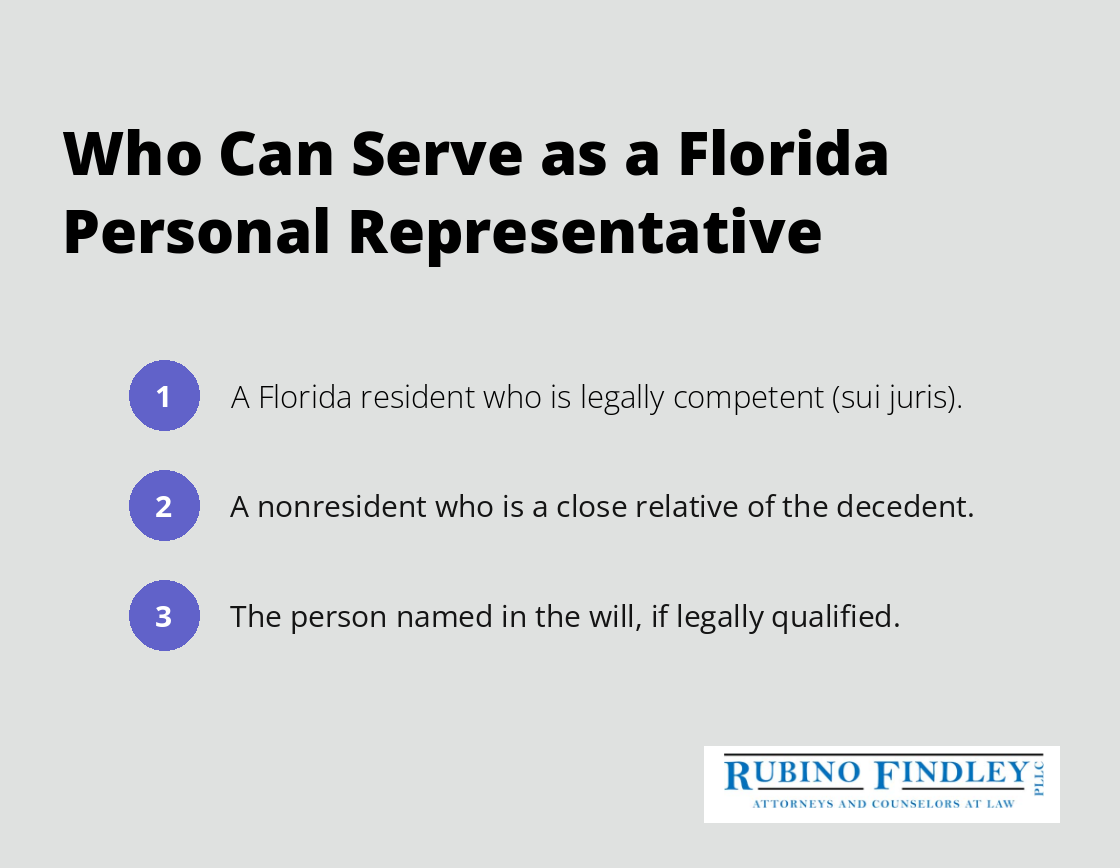
The personal representative (often called an executor in other states) is the person the court appoints to administer the estate. Under Florida Statute 733.302, a person who is sui juris and a Florida resident at the time of the death generally qualifies. Under Florida Statute 733.304, a person who is not domiciled in Florida may serve only if they fall within certain family relationships to the decedent, such as a spouse, child or other lineal descendant, parent, sibling, aunt, uncle, niece, or nephew, or the spouse of a person who qualifies. If the will names a personal representative, the court usually honors that choice as long as the person qualifies. If there is no will, Florida law sets a priority order that generally favors the surviving spouse, followed by the person chosen by a majority in interest of the heirs. The Florida Probate Rules also require a personal representative to be represented by a Florida attorney unless the personal representative is the sole interested person, which is why families rarely handle this process alone.
Why Probate Administration Matters Even With a Will
Many Boca Raton families assume that a valid will keeps an estate out of court, but a will alone does not avoid probate. A will tells the court who should receive the decedent’s property and who should serve as personal representative, yet the court still has to validate the document and authorize someone to act. Until that happens, banks will freeze accounts, title companies will not insure a sale of the home, and beneficiaries have no legal way to receive their share. Probate administration is the mechanism that turns the instructions in a will into actual transfers of ownership, which is why it remains a central part of most estates in Palm Beach County.
The Probate Administration Process Step by Step
Filing the Petition and Receiving Letters of Administration
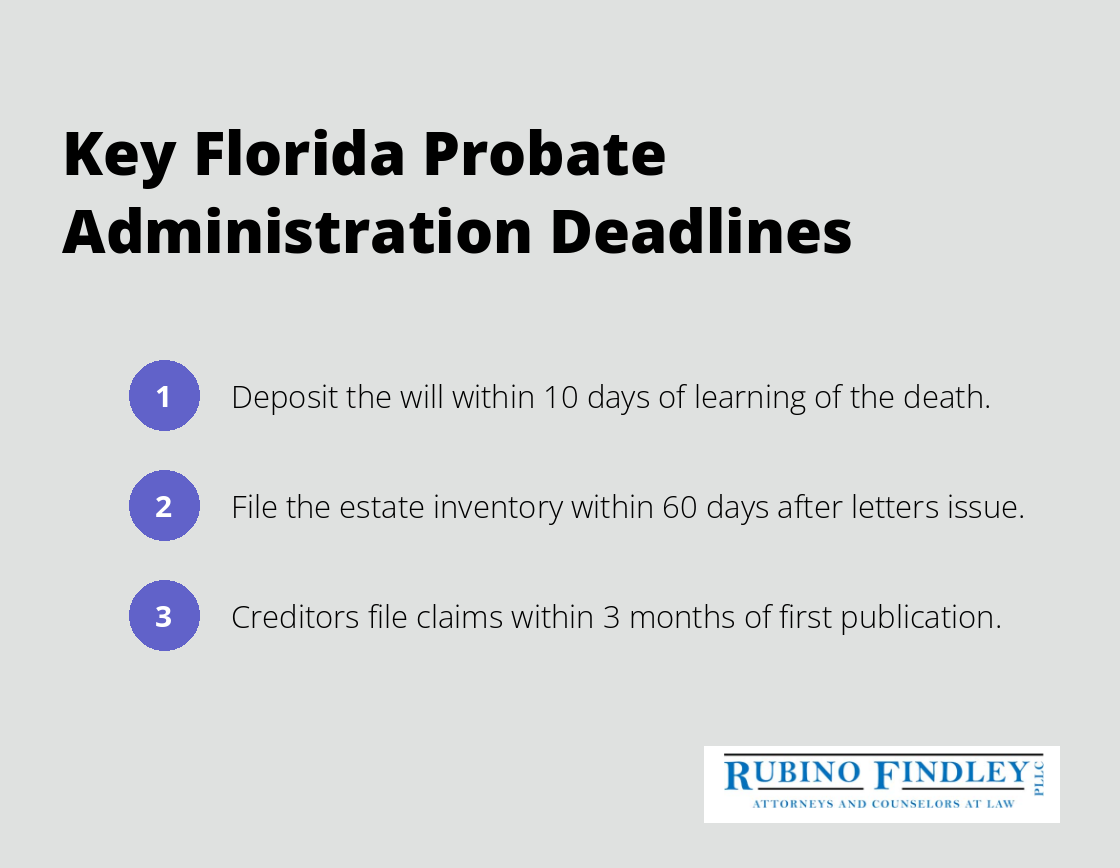
The process begins when the personal representative files a petition for administration with the Palm Beach County Clerk, along with the original will if one exists. Under Florida Statute 732.901, anyone holding an original will must deposit it with the clerk within 10 days after receiving information that the person who made it has died. Once the court reviews the petition and the personal representative takes an oath and accepts the appointment, the judge issues Letters of Administration. These letters are the document banks, title companies, and financial institutions will ask to see before they release information or assets. Without them, the personal representative has no legal authority to act on behalf of the estate. For a broader look at how each stage connects, you can review our overview of the Palm Beach probate process.
Notifying Creditors and Beneficiaries
After appointment, the personal representative must publish a Notice to Creditors, as required by Florida Statute 733.2121, in a local newspaper once a week for two consecutive weeks. Known or reasonably ascertainable creditors must also receive a copy directly. Under Florida Statute 733.702, creditors generally must file their claims within three months after the first publication of the notice or, for a creditor who must be served with the notice, within 30 days after service if that date is later. At the same time, the personal representative must serve a Notice of Administration on the surviving spouse, beneficiaries, and other interested persons. This notice tells them who is handling the estate, where the case is pending, and the deadline they face to challenge the validity of the will, the venue, or the court’s jurisdiction, which is generally three months after they are served.
Inventorying Assets, Paying Debts, and Distributing the Estate
Under the Florida Probate Rules, the personal representative must file an inventory of the estate within 60 days after Letters of Administration issue, listing the probate assets and their estimated values, and must serve a copy on the surviving spouse and on the heirs or residuary beneficiaries. From there, the personal representative collects and safeguards those assets, reviews every creditor claim, pays valid debts and expenses in the order Florida law requires, and completes remaining filing obligations for the decedent. Once debts and expenses are resolved, the personal representative distributes the remaining property to the beneficiaries, obtains receipts, and petitions the court for discharge. Because the creditor period alone lasts at least three months, even a straightforward estate takes several months to close, and our Florida probate timeline overview breaks down what to expect at each stage.
Common Mistakes That Derail Probate Administration
Treating Estate Money as Your Own
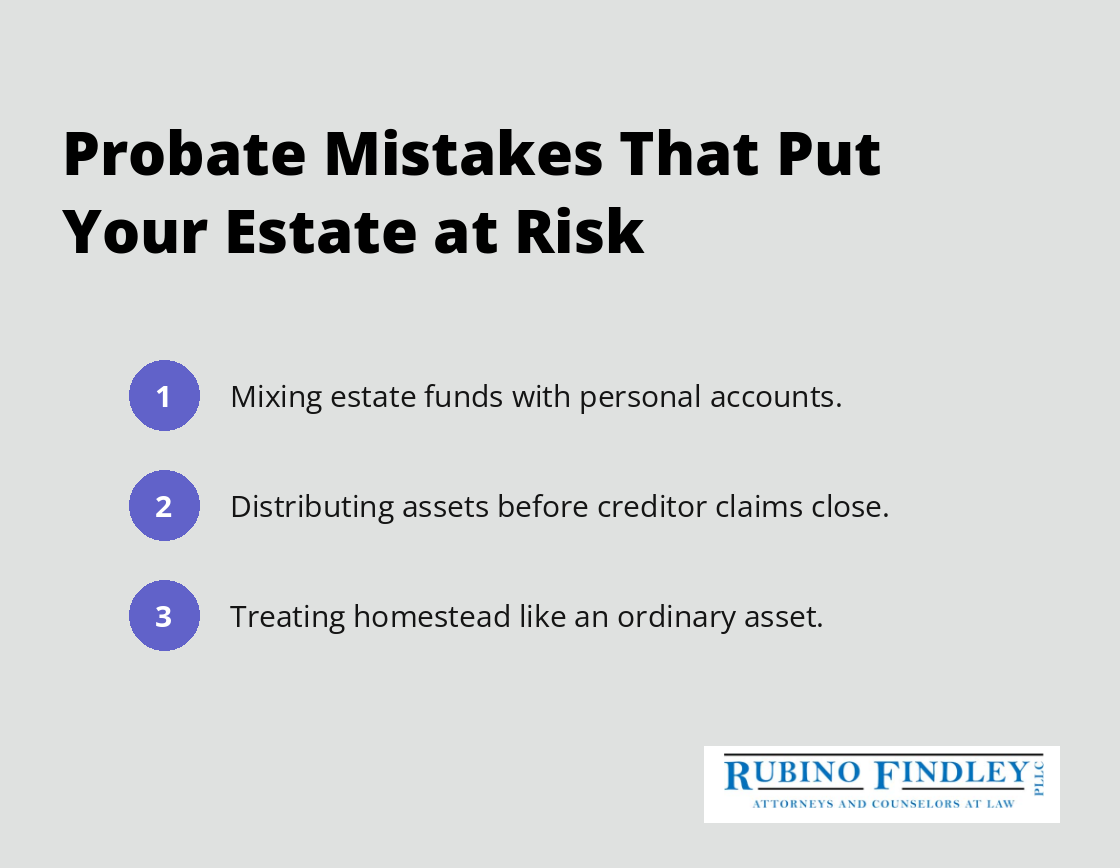
One of the most serious mistakes a personal representative can make is mixing estate funds with personal funds. All funds that belong to the estate should move through a dedicated estate bank account opened in the estate’s name. Paying a funeral expense from your personal account and reimbursing yourself later, or depositing a refund check into your own account, creates confusion that beneficiaries and the court may view as a breach of fiduciary duty. A personal representative in Florida is a fiduciary, which means the law holds you to a high standard of loyalty and care.
Distributing Assets Too Early
Families often feel pressure to hand out property quickly, especially when beneficiaries are eager or when the estate includes a home that sits empty. Distributing assets before the creditor period closes and before valid claims are paid can expose the personal representative to personal liability for breach of fiduciary duty. Patience during the first several months of administration is not a delay tactic; it is the safest way to make sure every obligation is met before anyone receives an inheritance.
Overlooking Homestead and Nonprobate Assets
Florida homestead property follows its own rules. Under the Florida Constitution, a homestead is generally protected from forced sale by most creditors, and that protection passes to the surviving spouse or heirs. The Constitution also limits how the owner may leave the homestead by will when the owner is survived by a spouse or minor child. Treating the family home like any other asset can lead to improper sales or distributions that a court later has to unwind. Personal representatives also frequently confuse nonprobate assets, such as life insurance with named beneficiaries, payable-on-death accounts, jointly owned property, and assets held in a living trust, with probate assets. Those items pass directly to the named recipients and generally should not appear on the probate inventory.
Ignoring Deadlines and Court Communications
Probate in Florida runs on deadlines, and the court expects the personal representative to meet each one without reminders. Late inventories, missed objections to improper creditor claims, and unanswered orders from the court can lead to removal of the personal representative or a delayed discharge. Creditor claims deserve particular attention, because a personal representative who fails to object to an invalid claim within the time Florida law allows may lose the ability to challenge it at all. Keeping a written calendar of every deadline from the day Letters of Administration issue is one of the simplest ways to keep the estate on track.
Final Thoughts
Probate administration in Boca Raton follows a clear legal path: the court appoints a personal representative, creditors and beneficiaries receive proper notice, assets are inventoried and protected, debts are paid, and the remaining property is distributed under court supervision. Each step carries its own deadlines and requirements, and a misstep at any stage can delay the estate or expose the personal representative to personal liability.
The good news is that you do not have to manage this process on your own. With proper guidance, you can meet every Florida requirement, keep beneficiaries informed, and close the estate in a way that honors your loved one’s wishes and protects your family’s relationships.
If you have been named personal representative or need help with a loved one’s estate in Palm Beach County or Broward County, contact Rubino Findley, PLLC to speak with our team in Boca Raton. We will walk you through each stage of probate administration and help you move forward with confidence.